
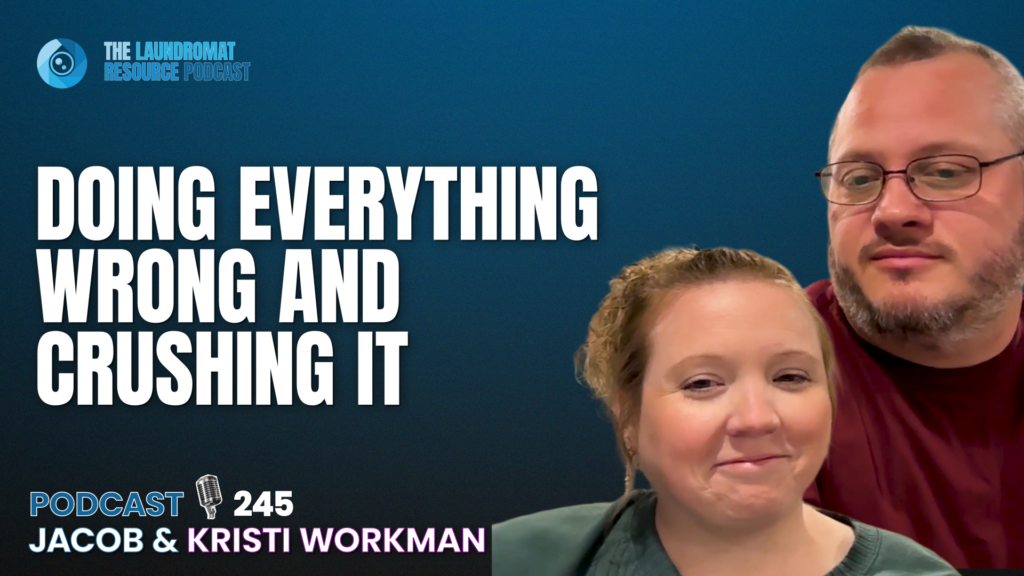
Welcome back to the Laundromat Resource Podcast! In Episode 245, Jordan Berry welcomes returning guest Jacob Workman and, for the first time, his wife and business partner, Kristi Workman. Together, they open up about their incredible journey of building a thriving laundromat portfolio—even after swearing they’d never get into the business. From their accidental entry into the industry and early struggles, through losing their first key location, to their smart, unconventional strategies for remote management and expansion, the Workmans share invaluable lessons, triumphs, and the nitty-gritty of running seven businesses—four laundromats, a car wash, and more.
This episode is packed with actionable advice and unique perspectives for aspiring and experienced laundromat owners alike. Whether you’re just starting out or looking to grow your own “laundromat empire,” you’ll find wisdom, encouragement, and maybe even a little inspiration in their candid story. Stay tuned to learn how thinking differently, playing to your strengths, and embracing unexpected opportunities can help you succeed in the laundromat industry.
1. Leverage Your Unique Skills and Advantages
Speaker B and Speaker C have actively used their maintenance skills and hands-on approach to buy, refurbish, and operate laundromats successfully—even ones that are distressed, poorly maintained, or far from their home base. At several points, Speaker A highlights how their “unfair advantage” (ability to fix machines, install equipment, do all repairs in-house) allows them to buy used assets, keep costs low, and quickly turn around struggling stores (26:30, 27:13).
Actionable Tip: Identify your unique strengths—whether it’s maintenance, marketing, deal negotiation, or systems—and use them as leverage in your business strategy.
2. Creative Deal-Making & Flexibility
The interview discusses multiple instances where Speaker B and Speaker C acquired laundromats under atypical circumstances: buying stores an hour and a half away, taking a short lease with an exit strategy (34:32), and securing a package deal of four profitable laundromats and a car wash with only $20,000 out-of-pocket through owner financing (42:12). They stress the importance of controlling the asset and considering terms beyond just the purchase price (50:06).
Actionable Tip: Be flexible and creative—every deal is unique. Look beyond general advice to assess risks and opportunities, negotiate for favorable terms, and always have an exit strategy.
3. Active Ownership, Team-Building, and Adaptation
Despite the allure of passive income, the conversation repeatedly returns to the commitment of active ownership, ongoing improvements, and hands-on management (28:06). Speaker B and Speaker C discuss running their locations remotely with smart systems (cameras, Alexa), employing and training teams, and being open to experimental changes, such as launching pickup and delivery (56:11), reorganizing wash/fold between stores, and adapting wash/fold pricing strategies.
Actionable Tip: Plan to be involved, especially at first; build a reliable team; use technology and systems to manage remotely if needed; continually adapt operations and services based on performance and customer demand.
Ready to Take the Next Step?
Check out Laundromat Resource for free courses, podcasts, community forums, and expert consulting—all from Jordan Berry , one of the industry’s leading voices. The opportunity in laundromats is real—whether you’re looking for stable cash flow, a business with meaning, or building wealth with real estate.
If you found these tips helpful, share them—and stay tuned for more industry insights from Laundromat Resource.
Resources and Links:
Make sure to watch the latest Laundromat Podcast Episode 245
Jordan Berry [00:00:00]:
Hey. Hey, what’s up, guys? It’s Jordan with the Laundromat resource podcast. This is show 245 and I’m pumped you’re here today. Today we have back on the show, Jacob Workman with his better half coming and sharing super valuable lessons that they have learned along the way building their laundromat portfolio. They have got a good thing going on, but they’ve gone through it and they share all the dirty details of their journey building their laundromat empire. This one is not to be missed. Whether you’re getting in for the first time or if you already own laundromats, there’s a lot of good stuff in here. So shout out to Jacob and his wife for coming on the show and sharing that.
Jacob Workman [00:00:46]:
Real quick.
Jordan Berry [00:00:47]:
Before we do that. Did you know, did you know that if you’re out there looking for a laundromat and you’re struggling, we’ve got a team that does that for you. So if you’re interested in learning more about that done for you, we call it our concierge package. That will help you find a laundromat deal. They’ll help you value that deal, will help you craft a compelling offer, and we’ll help you go through the due diligence process. I’m going to put a link down below. If you’re on YouTube, it’ll be in the show [email protected] show 2:45. If you want to check that out and just book a free call and get some more info on it.
Jordan Berry [00:01:29]:
I promise you it’s not a hard sell on anything. We don’t want anybody signing up for that package unless it’s going to be beneficial to you. So, you know, sign up for a free call. That’s your action step for today. Now let’s jump into it with Jacob Workman and talk about how to build a laundromat empire. And let’s borrow his lessons along the way. Jacob and Christy, how are you guys doing today?
Jacob Workman [00:01:54]:
We’re good. How are you, Jordan?
Jordan Berry [00:01:56]:
I am doing excellent. Super excited to have you guys on the show. Jacob, you’re back on the show. Christy, you’re here to upgrade this interview from. From our last one for sure.
Jacob Workman [00:02:07]:
Yeah, she’s here to run the interview.
Jordan Berry [00:02:11]:
We were talking beforehand. She’s here to take charge of this whole entire thing. So I’m excited about that. Well, thank you guys for taking the time. Come on the interview on the podcast and, and, you know, share some of your experience. And your knowledge along the way. I know we have some incredible things to talk about. But real quick, Jacob, you have been on the show before, and just in case you haven’t listened to before, that was episode 38, way back in the day, like more than 200 episodes ago.
Jordan Berry [00:02:38]:
Which is crazy.
Kristi Workman [00:02:39]:
Five years.
Jacob Workman [00:02:40]:
Five years ago.
Jordan Berry [00:02:41]:
Yeah. Yeah, that’s. That is crazy. So I’m excited to have you back on and hear the update of what’s been going on over the last five years. So real quick, just give us like a general overview. Who are you guys? How did you get in this business? And then we’ll start jumping into some of the details here.
Jacob Workman [00:02:59]:
So I’ll start. And then I guess I’ll let her pick it up because she joined me later on. Right. Quick overview. Years ago, my parents bought just the worst laundromat. You could ever buy it and replace a single piece of equipment. So we, we had to learn how to fix those. Got everything operational.
Jacob Workman [00:03:22]:
I helped them out, you know, on Sundays, do the little wash, dry, fold. And I swore that I would never get in to Laundromats famous last. That was. Yeah, yeah, that was 20 years ago. And fast forward to what, 2017. Yeah. And 2017 is where Christy comes in. I think it might have been her idea, I’m not sure.
Jacob Workman [00:03:47]:
But we actually bought our first laundromat location, the one I started our YouTube channel with. And we actually went in partnership with my parents on it, them as silent partners. And then we got things turned around there. Everything fixed, same process. And then we.
Kristi Workman [00:04:09]:
Well, today we own five.
Jacob Workman [00:04:11]:
Yep, now we own five.
Kristi Workman [00:04:12]:
Today we own five.
Jordan Berry [00:04:14]:
Okay. There’s lots to unpack there. And a car wash. Actually, I want to talk about the car wash too, so don’t forget to talk about that. But okay, I, I mean, I’m, I’m curious, Jacob, from your end. I mean, did you just get wooed into it by Chris? Like, how did you go from I’m never going to own a laundromat to owning one? Like, did she show a little leg? And you’re like, okay, we’ll buy one? Or how did that.
Kristi Workman [00:04:38]:
No, his. If you know Jacob, you know, he doesn’t have the best memory. He actually found this Laundromat on Craigslist
Jacob Workman [00:04:48]:
back when Craigslist was.
Kristi Workman [00:04:49]:
Yeah, on Craigslist.
Jordan Berry [00:04:50]:
It’s still a thing. You’d be surprised, man.
Kristi Workman [00:04:53]:
Yeah, it was about a, what, 45 minute drive from where we lived at the time. But, you know, still local, still close. So we went, we went in to it with his parents. So it was just a. It was a good deal.
Jacob Workman [00:05:12]:
Yeah, it was a. It was a good deal. I, I can’t remember any of the specifics, but we, we bought it outright and it just. Similar story. As you hear a lot of laundromats, they actually kept a record of how they took off muddy and they only took money off whenever they came to clean. And then going back and looking at that, there was times that they didn’t come for a whole week to clean the laundromat.
Kristi Workman [00:05:38]:
Yeah.
Jacob Workman [00:05:39]:
So it just had this awful reputation. Decent machines because they weren’t getting used enough because they, you know, they had such a bad reputation. And we actually added. One of the first things we did was added a couple 60 pounders and that place turned around that.
Kristi Workman [00:06:00]:
Yeah, it did really.
Jacob Workman [00:06:01]:
I still consider it one of our prettiest stores. I really enjoyed what we did with the floors and everything else, but yeah, it was a great store. Now we don’t have that store anymore, unfortunately. What?
Jordan Berry [00:06:16]:
Yeah. Which I want to ask you about here, say, but real quick. Just, I don’t know, you just kind of piqued my interest. What kind of floors did you guys do at that location?
Jacob Workman [00:06:24]:
We did the epoxy with flake.
Kristi Workman [00:06:26]:
You’ll have to sit in the picture.
Jacob Workman [00:06:28]:
Yeah, it was beautiful. But that man said I wouldn’t ever do it again.
Jordan Berry [00:06:33]:
Yeah. Why? I’m curious because I also did epoxy with flake and I probably also wouldn’t do it again. But I know some people love it
Jacob Workman [00:06:41]:
and swear it looks great, but the maintenance involved. Yeah, you can’t just mop it. You actually have to buy a scrubber to scrub it because the dirt gets up on the little ridges of the flight and, and you just, you can’t keep it clean. Every time after I, I would scrub it with our scrubber. I bought like a thing as a couple hundred dollar scrubber that wouldn’t hold water and you know, I had to fight with it, but it was great. Uh, but I’d scrub the floor and it looked like a brand new floor, but you know, I would never do the flake again. The epoxy was nice, but not the flake.
Jordan Berry [00:07:20]:
Yeah. Yeah. I had a similar experience. It was just so hard to keep it clean.
Kristi Workman [00:07:25]:
Yeah.
Jordan Berry [00:07:25]:
And just a lot, you know, I mean, obviously like laundromats, you get a lot of traffic going in and out and it, it, yeah, it was, it was tough to keep it clean, so. But some people love it, swear by it.
Jacob Workman [00:07:37]:
The worst was taking the, the Push broom and it. Hairs getting cold and.
Kristi Workman [00:07:42]:
And Lance.
Jordan Berry [00:07:44]:
Yeah.
Kristi Workman [00:07:45]:
And it was easy. I feel like for you all to put down, it’s a simple process.
Jacob Workman [00:07:49]:
It was a, it was a what a. I think a 48 hour job.
Kristi Workman [00:07:52]:
Yeah.
Jacob Workman [00:07:54]:
Because we did that in house. We do everything in house but you know, it’s super simple put down but it just. And just hard to keep clean.
Jordan Berry [00:08:05]:
Yeah. Okay. I was just curious what flooring you did there. Listen, I mean we’re going to get into store number two and owning remotely and picking up amazing deals and picking up four at once with the car. We’re going to get into all this stuff and talk about the details. But you kind of alluded to this already so I wanted to make sure we talked about this a little bit. You mentioned that you don’t own that first store anymore and can you give us a rundown of what happened with that one? And that was the one. I mean you mentioned too.
Jordan Berry [00:08:36]:
Sorry, real quick. You mentioned too that you at that store is where you started your YouTube channel that there. I fixed it. Right. Which I think you’re not doing as much anymore. Is that right?
Jacob Workman [00:08:46]:
No, I, I really need somebody to follow me around with a camera. Yeah.
Jordan Berry [00:08:51]:
So you ask, you know, because I will do it.
Jacob Workman [00:08:53]:
I’m. I would love to. I put out more content if somebody followed me around the camera and ended it. That’s a lot of people don’t realize there’s so much work into that.
Jordan Berry [00:09:04]:
It’s a lot of work. Yeah, it’s a lot of work.
Jacob Workman [00:09:07]:
Especially when you’re trying to fix something and you’re trying to get your own B roll. You know, you’re fixing stuff twice just so you can get a good shot. So I’d really, if I could ever find me someone that wants to follow me around, we’d like to get that. I’ve been, I have been trying to post up shorts just is just kind of, you know, if there’s something interesting I’m doing, you know, I think I posted one up yesterday. We actually finally built our warehouse which you know, we’ve been trying to do for, for years just to house our laundromat stuff. But I think we’re going to try to push to get it back into the YouTube stuff.
Jordan Berry [00:09:46]:
All right, I’m gonna, I’m just put it out there for you. If anybody out there is trying to get into this industry and wants a real hands on mentor and don’t mind walking around the camera, hit this guy up. There’s a win win in there. For you guys.
Jacob Workman [00:09:59]:
You’ll learn.
Jordan Berry [00:09:59]:
Yeah. Okay, so let’s talk about what. What happened with that first alarm. Why don’t you guys own that one anymore?
Kristi Workman [00:10:07]:
So we, like I said, we bought it in 2017. In the middle of 2023, that shopping center where the laundromat was located was sold. So we acquired a new landlord. We did have a lease at this laundromat with options to extend our lease. But the people who bought it, it was actually a mega church. And their plan was to build a mega church in the huge parking lot that was there, and then the shopping center would be the offices. So they offered us an addendum to the lease where we had the option to get out of this lease and leave whenever we wanted to. And likewise, they had the option to ask us to leave when they wanted to, and they asked us to leave a little bit sooner than what we, I guess, were expecting.
Jacob Workman [00:11:12]:
We’re told.
Kristi Workman [00:11:13]:
Yeah. And what we were told, really. And that was hard because at that time, he had actually quit his salary job to focus on construction. He was building houses. Well, we were building our first house. And then, you know, focus on the two laundromats we had. But that laundromat specifically was our livelihood. I mean, it’s took care of us.
Kristi Workman [00:11:42]:
It paid our bills. So having to leave, it was hard. It was scary for it, you know, for a little bit. It was scary for me. So.
Jacob Workman [00:11:54]:
And just to answer a question that’s. That’s, you know, for forefront of everybody’s mind, why’d we sign it?
Jordan Berry [00:12:03]:
That was gonna be my.
Jacob Workman [00:12:05]:
We didn’t have to sign it. And there was one. One per our. One business there that decided not to sign it. And they’re still there, but we chose to sign it because they’re telling us that they’re going to build the building, you know, and we’re going to have limited parking. We’re going to have limited access. You actually would have had to take a. A back access road to reach our laundromat.
Jacob Workman [00:12:30]:
We were just going to lose customers because it was inconvenient. And then we’re on the hook for the next, you know, 10 years for a lease payment that, you know, we’re unsure what direction that the building’s going to go. So turns out it was a hard decision to make, but it’s the right decision.
Jordan Berry [00:12:50]:
Yeah. Yeah. Well, it is scary because I know, Jacob, you left your job and you were doing this, and like, Chrissy, like you said, this was. This was the thing that was paying your Business.
Kristi Workman [00:13:01]:
Yeah.
Jordan Berry [00:13:02]:
So, I mean, that’s super scary when that goes away. I mean, you know, if anybody’s been in that situation or maybe a situation where you got laid off and you weren’t expecting it or something like that. Like, that’s a pretty scary situation to be in. But maybe we need to rewind a little bit, but somewhere in the middle there, you got a second laundromat. I will never own a Laundromat to. I own one. We own two.
Kristi Workman [00:13:28]:
Yeah.
Jordan Berry [00:13:29]:
How did that second one come about? And then maybe we can bring it all the way back up to the 2023. But how did that second come about?
Jacob Workman [00:13:37]:
So I think this one was, I think Facebook Market. Facebook or Craigslist? I can’t remember. I think Facebook, but I’m not 100% sure. Actually, I do. I do think it was Facebook, because if you’ve ever dealt with Craigslist versus Facebook, you get a lot more people messaging you on Facebook than you would somebody texting you on Craigslist. But I remember reaching out to this woman and saying, hey, I know you’ve gotten a ton of messages to the. On this. I’ve got.
Kristi Workman [00:14:07]:
Because it was not tenorant, but it was priced dirt cheap. Dirt cheap.
Jacob Workman [00:14:12]:
And we got it even cheaper. Yeah. But I text her and I said, hey, I’ve got money in the. In my hand. I’m ready to make a deal. I gave her my backstory, and that’s something I’d like to. To stress to people. Always tell people what you do, because you never know, somebody might be that there to help you or it might improve your chances on getting something.
Jacob Workman [00:14:35]:
So. And that’s what I did. I said, hey, we operate Laundromats. We’ve been in the laundromat industry X amount of years. I’m ready to make a deal on this. I’d love to look at it at your earliest convenience. And it just went from there. I went and looked at it.
Jacob Workman [00:14:52]:
Did you go in?
Kristi Workman [00:14:53]:
Yeah.
Jacob Workman [00:14:54]:
Okay. Yeah. So you went in. The lights were off. The lady that showed me the place, she was the owner. She didn’t know how to turn the lights on. I didn’t go exploring because it wasn’t mine. But I, you know, I looked the place over, looked at all the machines.
Jacob Workman [00:15:12]:
Like, I just. There wasn’t a machine with an out order sign on it. But being around laundromats, I could tell, you know, she even had one that was running water that needed diaphragms. Just letting it run like it was. If I’m not Mistaken. I might have went down and fixed that for her just because she was. She was losing on it.
Kristi Workman [00:15:35]:
Yeah.
Jacob Workman [00:15:36]:
This was right in the middle of COVID wasn’t it? Yeah, tail end. Yeah, the tail end of COVID and Sherry just. It was just going to pieces on them. So we actually ended up making a deal with that. And once we get the leases settled out of the litigation, the lawyers and all that, we got our lease. We actually assumed their lease because they had no numbers. So we assumed their lease and then wait, it’s now roughly each month it makes almost as much money as we bought it for.
Kristi Workman [00:16:13]:
Yeah, so. So it’s paid for itself several times over every month.
Jacob Workman [00:16:17]:
Yeah. Yeah.
Jordan Berry [00:16:19]:
That’s in. That’s incredible. Well, I mean, this probably goes without saying, but tell me a little bit about how this thing was doing when you took over. Like, did you get some, like, baseline numbers? Was it making any. Was anybody coming there at all, or
Jacob Workman [00:16:33]:
how was that, like, baseline numbers? I do have baseline numbers. It wasn’t even making $200 a day. Yeah, the first day I went in and it was hours. I pulled a trash can up and there was 20 cockroaches. That just scary.
Kristi Workman [00:16:51]:
It was a zombie mat.
Jacob Workman [00:16:52]:
Yeah, it was so bad, I didn’t even want to be there.
Kristi Workman [00:16:55]:
Yeah, I didn’t want to go in. I didn’t want to be there.
Jacob Workman [00:16:58]:
But the first day they were. We learned that they were manually unlocking and locking the doors we were supposed to take keeps their cleaner, which we found on closing, that their cleaner didn’t want to come help us and stay. So that was a blow because we lived an hour, 15 hour, 30 minutes. That’s.
Kristi Workman [00:17:17]:
I was going to say this location is about an hour and a half from us.
Jacob Workman [00:17:22]:
So, yeah, it was a blow. We. I went up there. I usually don’t work on Sundays. I went up there on a Sunday because we closed on a Saturday, went up on a Sunday to go through. And the first day I put mag locks on and, you know, our alarm system, security systems. And I met a guy up there, and he become my cleaner. For the longest time, he had just so by happenstance met him.
Jacob Workman [00:17:55]:
And then we just slowly started fixing everything we actually fixed. We went through there. Like I said earlier, there wasn’t a single out of order sign on them. So we went through and tested every machine.
Kristi Workman [00:18:08]:
There was also no number. Like, if a customer had a problem, there was no way for that customer to get in touch with anyone to, you know, I always get their money.
Jacob Workman [00:18:19]:
It was. It was better for you to go next door and play the lottery than come in there and get a machine at work. More than. More than half. Didn’t work more than half. And there was 65 machines, I think, but we actually fixed 28 machines in the first day. So. And my dad.
Jacob Workman [00:18:39]:
My dad went up to help me and we got it knocked out. It was just all little simple things. Like there was a money box there. She walked. I don’t know if I mentioned this or not, but when we took over, she walked away. She didn’t take no money out of the box. She didn’t take no money out of change machine. I don’t know if you’ve ever dealt with an acquisition of, you know, do you want to fight over counters and they in the change machine or what do you want to do? But she just walked away.
Jacob Workman [00:19:07]:
And I mean, she left us thousands of dollars in cash.
Kristi Workman [00:19:10]:
Yeah.
Jacob Workman [00:19:10]:
Behind.
Jordan Berry [00:19:12]:
She was over it. She was done.
Kristi Workman [00:19:14]:
Yes, she was over it.
Jacob Workman [00:19:16]:
Was. She was over it.
Kristi Workman [00:19:17]:
But I just want to add, I think, to us, like her knowing that we had experience with laundromats, I think that helped us because she was done. She did not want to be like.
Jacob Workman [00:19:30]:
Didn’t want no callback.
Kristi Workman [00:19:31]:
She didn’t want no callback. She just wanted to walk away.
Jordan Berry [00:19:35]:
Yeah.
Jacob Workman [00:19:35]:
And yes, she got that. But it was just all little simple problems. There was actually one machine that they didn’t think they had the key to, and it turns out it just had a security feature that wasn’t lined up correctly. And you just. I just put the key in and there was $300 in that box. So. And now we’ve replaced all the dryers and had the old Maytag dryers that, you know, are just terrible in my opinion.
Jordan Berry [00:20:06]:
But
Jacob Workman [00:20:08]:
we replaced the dryers and now we’re replacing the floors and.
Kristi Workman [00:20:12]:
Yeah, for a while. For a while it wasn’t profitable. And especially up until that point that our first one had closed, it was. The second location was not profitable. But then when that one closed, and faith is a big part of our lives, God took care of us the whole time. We never wanted for anything. But when we closed or when the first one closed, we then took like all of our resources that we had and invested into that second one. And that’s what I guess jump started the, you know, of how well it’s doing now because like I said, it’s paid for itself.
Kristi Workman [00:20:58]:
It pays for itself monthly, over and over again. So.
Jordan Berry [00:21:04]:
Well, listen, you can’t just drop something like that and not tell us, like, what was what was the difference maker. I mean it was kind of, sounds like it was kind of bad for a while. Then it sounds like it was kind of coasting for a little bit and now it’s. Yeah, seems like it’s thriving. Like what, what were the things that you did or the decisions you made to make this thing make money?
Jacob Workman [00:21:24]:
We did let it coast for a while and yeah, we just let it. We were thinking about getting back out of the laundromat industry. So we was going, we were actually, I put it up for sale a couple of times because we were going to go full time into construction and then we just started, I don’t know, we, we started investing more money and
Kristi Workman [00:21:46]:
it wasn’t like we didn’t put brand new machines in it. Um, we didn’t put, you know, credit card readers on it. It wasn’t anything like that. I think it was just him going up there and making sure everything is working, making sure that the laundromat itself looks good. We got like he had told you, we got a cleaner. We actually have two cleaners now, which makes a huge difference. And just little things like that.
Jacob Workman [00:22:21]:
And there for the longest time when, and I know we make it gloss and over. It makes it sound like it’s all rainbows and sunshines but. Before I quit my salary job, I was working. I would get up at 3:30 in the afternoon, I would start my shift at 4:30, end at 4:30 in the morning. I would go to our first location and clean it. Then I would travel an hour and a half to clean and maintain our second location. And there was many days that I didn’t get in bed until 11:30, 12:00 clock and have to wake back up at 3:30. But you know, like I said, we let it coast for a while just because we weren’t sure if we were going to keep it or not.
Jacob Workman [00:23:02]:
And then once I guess we finally decided we were going to keep it. Yeah, I think we finally decided we were going to keep it. Once we lost the first location, I think that was the turning point. We just, we turned it up to 10. We started doing the things that needed to be done and, and really it’s just been keeping it clean and we’re able to keep our prices lower than everybody. We don’t do that on purpose like in our other laundromats. We try to be the, the price leader, but we’re still making a great profit at what we’re priced at. There’s really no reason for us to, to try to keep up with everybody else.
Jacob Workman [00:23:43]:
So. But I mean, it. It invests for its. Itself. It pays for itself. It’s actually. It’s bought new washers for the self. They’re.
Jacob Workman [00:23:53]:
They’re actually in storage getting ready to be installed.
Kristi Workman [00:23:55]:
Not brand new.
Jacob Workman [00:23:56]:
No, no, no. We don’t buy anything brand new. Very rarely do we buy anything brand new. We like to buy used stuff. Uh, we’ll go through it. Uh, we completely refurbish it. We can do all our bearing jobs. Anything you can need to be done with a washer or dryer, we can do.
Jacob Workman [00:24:14]:
So that’s what we try to use to help pass that savings on to our customers.
Kristi Workman [00:24:20]:
Also want to say, and I told you, but this location, it’s an hour and a half away from us, so we run it remotely. We do have cleaners, but we do run it remotely. And Jacob has this weird spotty sense about this laundromat. I mean, he can be like, I need to check the cameras, and he checks the cameras, and then something sketchy is going on. So he’s got this weird spotty sense that he’s developed with this laundromat.
Jordan Berry [00:24:49]:
Well, I. I mean, I just have to say I can attest to this, because before we hit record, he’s like, hold on a second. My spidey is tingly. And he pulled up the cameras. He’s on. He’s on the camera saying, hey, no dogs allowed in here. And if you’re not doing laundry, get out. Like, it happened, like, right here live.
Jordan Berry [00:25:06]:
I wish we had been recording it. That would have been great to snag that. But I can. I can attest to that. But that was going to be one of my questions. But real quick. I mean, you mentioned that the, you know, you’re. You’re kind of able to.
Jordan Berry [00:25:19]:
To buy. Use equipment because you feel like you can go through and make sure that these things are working. Anything that needs to be done with the machines, equipment, you guys can do. There’s, you know, that’s hotly debated whether owners should be doing that or not. But here’s my point, and the debate can rage on. That’s fine, because I don’t think there’s one right way of doing it. Also, by the way, I just want to let you guys know you’re doing it wrong. You’re not supposed to buy them an hour and a half away from you.
Jordan Berry [00:25:46]:
So you’re doing it all wrong there as well. But the point I want to make is, is that, uh, one thing that you guys are utilizing that’s bringing you a lot of success. And that I see a lot of other owners who are very successful in the industry is finding out where is your advantage, where’s your unfair advantage? Where do you have a skill or resource or something like that that not everybody has that you can use as leverage to help you be successful? Right. And you happen, Christy, you happen to have a workhorse mule sitting right next to you who can fix these machines, who can install the machines, who can do flooring, who can do all the stuff. Right.
Kristi Workman [00:26:29]:
Yeah.
Jordan Berry [00:26:30]:
And that’s the lever that, that you guys have been able to pull, or at least one of them that you’ve been able to pull in order to make this successful. And, you know, I have, I have like, clients, for example, who are, you know, they have a lot of experience in marketing, and so they’re pulling the marketing lever. Finding a lot of success with that. Right. Or systems or, you know, deal finding or whatever. But I think it’s super important and something you guys have done really well to find what’s your unfair advantage and how do you utilize whatever that unfair advantage is for you to, to help you build a successful business? Right. Which kudos to you guys for that.
Jacob Workman [00:27:13]:
I appreciate it, though. That is something that always, you know, anytime I buy a business, we have seven businesses. Anytime we get into a new business, we look at how can we be different than everybody else and then what’s our exit strategy if it don’t work out? So we’ve always got an exit strategy on how we can utilize the space better. But yeah, the Lord’s blessed us to be able to have the knowledge, to have the skills and to have the tools and something we have to say. And we pre face this to a lot of people, we’re active investors. We’re not passive investors. We choose to run our, our laundromats actively. We have, we have Manager, we have 13 employees, but we choose to be right there in the trenches with them.
Jacob Workman [00:28:06]:
That way we can see what’s going on in our business and adjust it on the fly instead of reviewing it at the end of the month. Yeah. And if I’m at home, I, I, I got to go to work. I can’t.
Kristi Workman [00:28:18]:
Yeah, he has to be working, so.
Jordan Berry [00:28:20]:
Yeah. Yeah, I, well, and I love that too. And you know, I think there’s a lot of people who, their initial interest is peaked in this industry because of the whole passive income.
Kristi Workman [00:28:32]:
Yeah.
Jordan Berry [00:28:32]:
Message. Which, I mean, listen, you can set it up that way and you can make it, you know, maybe not entirely Passive. But you can be a lot more passive than you guys are and still have some success and make money and serve the community and do all those things. But you know, when, when you’re first getting in, you should plan on being active. And if you want to end up setting your business up to be more passive, okay. But I would not go into this business expecting it to be passive. I mean, unless maybe you got boatloads of money and you’re just going to throw money at problems, which, yeah, kudos to you if that’s where you’re at there. But that’s big.
Jordan Berry [00:29:13]:
So I wanted to go back and ask a question about buying this second laundromat because I was kind of joking about it earlier. But if you go, if you go online on like one of the Facebook groups or something like that and you say, hey, I’m buying a laundromat an hour and a half away from you, you’re gonna get destroyed by all the experts telling you not to do that. So I’m curious why, why buy an hour and a half away and how have you made it so that you can manage this thing being so far away?
Kristi Workman [00:29:46]:
I think we bought it because it was dirt cheap. Honestly, it was dirt cheap. And we knew that we had the knowledge and the know how to just turn it around. Yeah, we knew that we could make it work. And it has. But you can share what you’ve done to make it.
Jacob Workman [00:30:06]:
Yeah, I mean, yeah, she hit the nail on the head. That’s the exact reason why we bought it. It’s dirt cheap. We can make money and then, but also build into that early on we still had the exit strategies. Worst case scenario, we pull the equipment out, sell the equipment, it covers what we, we, we spent for on the place and no harm, no foul. I mean, I think that we had a year and a half left on lease that we assumed and that’s why I assumed it, so that we could see is there profitability here. And then once we figured out there was, we just started up a brand new lease, but everybody will get on there. You know, you might get murdered in those comments, but you’re also going to have the people that saying, hey, add this, add that, add this.
Jacob Workman [00:30:55]:
So we’ve got, you know, of course we, we have what I call two sets of cameras. I have my cameras that I need to go back on and you know, there for my protection. And then I have my cameras there for the laundromats protection. And those are the cameras that rotate. They can, you know, they can flashlights, they can do anything just to get people’s attention. But I also use utilize Alexa. So with Alexa we use Alexa to play music primarily in our, all our brush spaces. But when you heard me talking earlier, that’s what I was doing.
Jacob Workman [00:31:30]:
Alexa has a drop in feature and it’s just like a phone call. You press that button and you’re able to just, you know, say announce whatever you need to announce. But we have everything on automatic. Timers, our lights are on timers, the door, our doors and then those cameras. Also after one hour after we close, they start looking for people. They, they’re smart cameras and they’ll just send me alert that you know, when we get somebody that’s trying to stay the night or whatever, we just get on there and you know. And also with that being said, I have a redundancy system in. After about an hour and 15 minutes of us being closed, the announcement system plays a, you know, hey, the, this security system is now alarmed.
Jacob Workman [00:32:17]:
Anybody called in here, you will be trespassed. You know, just some mumbo jumbo that if somebody heard it they’d freak out and they left. And usually that’s what, that’s what, that’s all it takes. Yes, but other than that, you know, I have an emergency key hidden. That way if I get. Because we’re still quarter based at that store and you see a lot of people on the, you know, the card systems, whenever they’re, they’re far away. But we’re still quarter based. We have pay range, we have the remote, remote start option with pay range and that helps out a lot being you know, an hour and a half away.
Kristi Workman [00:32:52]:
But you actually use that often?
Jacob Workman [00:32:55]:
Yeah, often, yeah. Instead of refunds, people just like people’s very happy to just throw my clothes over in another machine or you know, if they, if it’s their fault, just put the money on there, they’ll be happy. But we actually have a key hidden there that we have a trusted cleaner that if I have to, I say, I text him and I say, hey, could you dump XYZ boxes? Basically, if you’re in the laundromat industry, it’s the 60 and the 40 pounders that you’re dumping. So he’ll dump those out. That’ll last me another three or four days because we have four change machines in there or two, two change machines. That way we don’t run out of money. So that’s how we handle our Laundromat an hour and a half away.
Jordan Berry [00:33:41]:
Yeah, well, listen, well I, I Just, I don’t want to be the bearer of bad news, but you’re just doing a lot of things wrong here. The all coin thing, the year and a half lease, like, these are all. I know, but I mean, here’s the thing, though, right? It’s like, first of all, let me just speak to somebody looking to buy a laundromat who’s trying to get advice on these Facebook groups. Listen, if you’re going to be dropping tens or hundreds of thousands of dollars, or even seven figures, depending on what you’re buying, probably don’t just crowdsource your information because you don’t know where that information’s coming from. Right? That’s number one. Number two is, you know, there’s some really good general advice out there. Like, generally speaking, it’s your first laundromat. Buying an hour and a half away is going to be tough unless you have your life situated that way.
Jordan Berry [00:34:32]:
Generally speaking, if you’re going to be, you know, you know, a mile and a half out, you got to have a cashless payment system, which you have pay range, which helps, you know, all that stuff, right? So there’s some, like, general stuff, but, you know, and generally speaking, you want a longer lease, right? When you’re doing this, however, you know, what I love about you guys is that you’re. You’re using your heads. There’s some principles out there, but you’re using your heads and you’re saying, hey, look, we can stick with a year and a half lease because worst case scenario, the way that we bought this thing, we can sell the equipment, break even, move on, go into the construction business. You know, Jacob can sell foot pictures online or, you know, whatever after that, right? So you had that exit strategy up front, and so it gave you. It actually made it less risky for you to have a shorter lease because now you have some information to work with which you had no information before, right? So there’s some good principles out there, but you can’t take them as hard and fast rules. You’ve got to assess the situation. I think you guys are genius at doing, like, you’re just describing all these things. I know.
Jordan Berry [00:35:38]:
We’ve got another really big deal that we’ve got to talk about here, which is another genius play by you guys. But you have these, like, genius moves that you’ve made in order to be able to, you know, find that success. And a lot of it just has to do with you guys taking a second, using your brains and, and being methodical and being smart and working Together with each of your different strengths, which seems like you have complementary strengths. Do you guys have.
Jacob Workman [00:36:05]:
For sure.
Jordan Berry [00:36:05]:
Do you guys have different roles, like defined roles for you guys or how, how do you guys. I know you guys are doing this together as a couple, which also has some challenges. How do you guys set that up?
Jacob Workman [00:36:17]:
Well, actually, this year we. We’re now W2 employees.
Kristi Workman [00:36:21]:
Yeah.
Jacob Workman [00:36:22]:
Again for ourselves, of course. So their own businesses, you know.
Kristi Workman [00:36:26]:
Yeah, yeah.
Jacob Workman [00:36:27]:
Obviously that’s, that’s our tax savings. But I am maintenance coordinator and she’s HR specialist. Yeah.
Kristi Workman [00:36:35]:
So he does like all the maintenance and then I handle all of the financial things and then HR related things. So.
Jordan Berry [00:36:43]:
Yeah, dude, I love it. I love it and I mean it. You know, I’ve, I’ve talked about this a bunch before, but, you know, there’s. There’s a, A book called Rocket Fuel by Gino Wickman and he talks about, you know, if you can have somebody who’s kind of got the big picture and then somebody who’s sort of in the trenches doing like the running the operations. Like you’re. You’ve got Rocket Fuel going your business. Like, you guys have seven businesses. Like, there’s not a lot of people that have seven businesses.
Jordan Berry [00:37:16]:
You guys are crushing it. And a big part of that has got. Because you guys are working together really well. I think I’m married, I’m sure also is not all rainbows and. And. Yeah, yeah, yeah, you’re best. I’m going to tell you, man.
Jacob Workman [00:37:29]:
Genius.
Jordan Berry [00:37:30]:
Genius.
Jacob Workman [00:37:30]:
Yeah, we have. We have. Which you know that we’re fixing to talk about it soon, but we, we have a manager and we all three sit down weekly to, to discuss things. She’s our, our manager of operations. Sometimes she jokes that she’s our mediator because we don’t see eye to eye on pretty much anything, but we work together. Yeah, we work together. It’s a good not seeing eye to eye.
Kristi Workman [00:37:55]:
Yeah.
Jordan Berry [00:37:56]:
Uh,
Jacob Workman [00:37:58]:
but yeah, no, I think I’m married. Pretty good.
Jordan Berry [00:38:01]:
Yeah. Yeah. Good. Kudos to you, man.
Jacob Workman [00:38:03]:
Good work.
Jordan Berry [00:38:04]:
Most financially beneficial decision you made right there.
Jacob Workman [00:38:09]:
All right. Yeah. Started from the trenches.
Kristi Workman [00:38:13]:
Yeah.
Jordan Berry [00:38:14]:
Yeah. Well, and, and a lot of times, you know, if you get that sort of different perspective, not seeing eye to eye thing, that’s where. That’s where good things can happen if you can figure out how to work together. Right. Because I, I know there’s a lot of times where you can’t see eye to eye. And, and there’s no empathy in that, you know, partnership in terms of at least the business Stuff. And things can be really difficult, and I’m sure they’re difficult at times anyways, because it always is. But if you can kind of have that empathy, it’s sort of that iron sharpens iron concept.
Jordan Berry [00:38:50]:
Right. Where you have different perspectives, different ideas, and they come together to form a super idea sometimes, which is great. Okay, so I wanted to ask you. You’ve got. You’ve sort of teased this already, but you. You got another deal that had, I think, four laundromats and a. In a car wash all.
Kristi Workman [00:39:12]:
Yeah.
Jordan Berry [00:39:12]:
As part of it. Let’s talk about that. Where did that come from? And how did you know. How did this come about?
Jacob Workman [00:39:20]:
Driving down the road.
Kristi Workman [00:39:21]:
Yeah, Driving down the road. We were actually taking his mom to a doctor’s appointment, I think to Knoxville. And she was looking on Facebook for, I think, something for her dryers, some dryers for herself. And I was, you know, we were looking together. I was looking down at her phone, and I saw someone say, I’ve got four for sale in the town that we live in. And I didn’t know what he was talking about at the time. I didn’t know if he was talking about dryers. I didn’t know what he was talking about.
Kristi Workman [00:39:56]:
But until Jacob. And Jacob knew who I was talking about, and he was actually talking about laundromats that he had for sale. So we called him. Now, he called us. Yeah, I gave him our number, and he called Jacob, and it was four laundromats and a car wash. And we talked for a while.
Jacob Workman [00:40:22]:
Yeah, but just a little. Couple of snippets here. A. We already did business together, so he did business. My. My construction company did business with his. So he was a subcontractor for us.
Kristi Workman [00:40:34]:
Yeah.
Jacob Workman [00:40:36]:
And then he was actually a subscriber to the YouTube channel.
Kristi Workman [00:40:39]:
Yeah.
Jacob Workman [00:40:40]:
So, yeah.
Kristi Workman [00:40:43]:
But, yeah, he. We called and he. We talked for a while. We actually ended up saying no. We thought about it. We said no because we had thought about getting out of the laundry business all together. And then he come back. Yeah, we said no again.
Kristi Workman [00:41:07]:
And what year was this? This was 2024. Early 2024.
Jordan Berry [00:41:14]:
Okay.
Kristi Workman [00:41:14]:
Yeah.
Jordan Berry [00:41:15]:
So it was after. After that first one went away.
Kristi Workman [00:41:18]:
Yeah, after that, we just had the second, and we had thought about getting out of it. So the third time, we had took our little girl to the mall to get out some energy, and we actually ran into him there, and he recognized. We had never met in person. He recognized Jacob from his YouTube channel, and he pretty much. He sold it to me there, I think we were standing in the mall talking for, like, an hour. He sold it to me, and he actually offered us a deal that was too good to pass up. So we kind of felt. I told you earlier.
Kristi Workman [00:42:00]:
We. You know, we. Faith is a big part of our lives, and I feel like that was. That was God saying, hey, here it is. You need to take it. So.
Jordan Berry [00:42:11]:
Yeah.
Jacob Workman [00:42:12]:
Okay.
Jordan Berry [00:42:12]:
Okay. So first of all, I mean, genuinely is, like, the power of having a platform. Right. Putting yourself out there. And, you know, these. These deals maybe wouldn’t have happened and maybe not the way that it happened had you not had your YouTube channel. So if you’re not out there creating some content, it’s a lot of work. So think about it carefully, but might be worth doing.
Kristi Workman [00:42:35]:
Yeah.
Jacob Workman [00:42:35]:
Not to cut you off. And that was one of his things he said to us is. He said, I want to sell to you guys because you have the experience. Yeah. I’m not gonna have to deal with these later on. And I’ll just be honest with you. He owned or financed him for us, and it solved the problem. He had solved the problem.
Jacob Workman [00:42:53]:
We had. We got in it for, I think, $20,000 out of pocket.
Jordan Berry [00:42:59]:
So four laundromats and a car wash. Yeah.
Kristi Workman [00:43:03]:
Four very profitable laundromats. Yeah.
Jacob Workman [00:43:09]:
And he wanted out of them. He hated them. He didn’t have the time to deal
Kristi Workman [00:43:14]:
with it because he was also running a very busy, successful business, you know, separate business, and he just didn’t have time for the laundromat.
Jacob Workman [00:43:26]:
He was. He was done with it. So, like. Like I said, he. He wanted to sell to us because he knew that he wasn’t ever gonna have to deal with these things again. So it worked out great. But with that, we inherited, what, 10 more people? 11 more people, I think 11 more people is what that. Yeah.
Jacob Workman [00:43:47]:
So now we have a fleet of vehicles and a fleet of our company of people and Lord’s blessing us each day. And I won’t get ahead of myself.
Jordan Berry [00:44:02]:
Yeah. Well, and I wanted to point out, I mean, because this is sort of a theme from that second one to now. These ones. There’s, you know, there. Another, I guess, kind of hotly debated topic there is do you need to hit a home run on that first one? I’m. I am in the camp that go get a base hit. Go get a base hit or a double. It doesn’t have to be a home run for that first one for a couple reasons.
Jordan Berry [00:44:30]:
Number one, a base hit in this industry is still a pretty darn good return on your investment. Number two, I have found, and you guys are demonstrating this over and over and I’ve seen this happen lots of times this happened to me. But as soon as you have that first one under your belt, people see you as experienced. They don’t even have to know if you’re a good owner or not. I always kind of half joke, but I wasn’t really joking that I got a seller finance deal in LA with property because I had already owned a Laundromat, even though at the time I was probably the world’s worst laundromat owner, trying to figure out what the heck was going on. And so once you have your foot in that door, a basic deal is going to be good, but other opportunities open up to you. And all of a sudden the lady who’s selling her laundromat that’s eventually going to make the purchase price every single month at that Laundromat is like, if I sell to these guys, they have experience. I’m not going to have to deal with it anymore.
Jordan Berry [00:45:25]:
I’m going to sell to them and for less than what I’m asking.
Jacob Workman [00:45:28]:
Right.
Jordan Berry [00:45:29]:
Or this guy who’s got a, who’s got a four pack deal with a car wash is going to sell to you and only require 20k down, which is unheard of. Right. And so get your foot in the door, go find that first one and see what happens. You know, be faithful, that first one and see what happens.
Kristi Workman [00:45:49]:
Yeah.
Jacob Workman [00:45:50]:
With that deal. And I’ll just tell you, yeah, we weren’t scared. We overpaid a little bit. We do, but we ran the numbers. The numbers come back good. The numbers continue to come back good. The futures look good. So, um, I guess we can’t really consider that we overpaid.
Jacob Workman [00:46:08]:
I guess by industry standards some people would have a heart attack. But you know, I’m, I’m not a. I don’t know, I have to. Even if there’s a text manual, I have to, I have to create my own manual for myself. She gets mad about at me a lot about it.
Kristi Workman [00:46:26]:
Well, and I just, I wanted to go back and add in that deal. It was four laundromats and a car wash, but it also come with three buildings. So.
Jacob Workman [00:46:36]:
Three.
Kristi Workman [00:46:37]:
Yeah, three. Real estate.
Jacob Workman [00:46:39]:
Four actually.
Kristi Workman [00:46:39]:
Yeah, four. I mean, so $20,000 out of pocket. We got a heck of a deal.
Jordan Berry [00:46:49]:
Got nine assets out of that thing.
Kristi Workman [00:46:51]:
Yeah, assets too. We may have overpaid, but we would not be in the position that we’re in right now had we not have took this deal.
Jacob Workman [00:47:02]:
And then.
Jordan Berry [00:47:03]:
Yeah, I mean, go ahead, keep going. Yeah.
Jacob Workman [00:47:06]:
Oh, I was just gonna say just from that. We’ve just always left that be a part of our strategy. Always in the back of our mind that that’s, you know, hey, here’s what we got going on. Here’s, you know, anything we do in the future, we need to also consider what we’ve done in the past.
Jordan Berry [00:47:25]:
Yeah, yeah, absolutely. And, you know, I. I was kind of setting this up earlier of just, you know, you. You doing things wrong again. I mean, listen, you overpaid. Like, you’re just doing things right. Like. But again, just the genius of what you guys have gotten going is number one.
Jordan Berry [00:47:44]:
I mean, I’m curious, actually, before I say this, I’m curious. You said that you said no to him twice before you said yes. What? Why did you say. I know why you said yes. When he kind of made you an offer you couldn’t refuse, why did you say no beforehand? Or why was it not the right deal beforehand?
Kristi Workman [00:48:03]:
So the yes was when he offered to.
Jacob Workman [00:48:06]:
Yeah.
Kristi Workman [00:48:07]:
Finance.
Jacob Workman [00:48:08]:
If you’ve ever been through trying to buy and sell a Laundromat.
Kristi Workman [00:48:11]:
He had no numbers.
Jacob Workman [00:48:13]:
Not great numbers. We knew, like, we knew what the actual numbers.
Kristi Workman [00:48:19]:
We knew what the actual numbers were, but he didn’t keep a record.
Jacob Workman [00:48:24]:
All the, all the. Of course, you know, all the banks want to see the RS statements and, you know, the tax statements and, you know, if that stuff’s not there, then you’re not. You’re not going to make a deal.
Kristi Workman [00:48:36]:
It was hard. It was going to be hard to get a bank to finance that because we tried. Yeah, we tried.
Jacob Workman [00:48:43]:
They wouldn’t even call us back.
Kristi Workman [00:48:44]:
They wouldn’t call us back. So we. We had to say no. And then he came back with, well, I’ll owner finance them. And.
Jacob Workman [00:48:53]:
But it worked out for him, too. It was actually his accountant’s idea because it saved him on capital gains and. And just. It makes more sense.
Kristi Workman [00:49:01]:
Yeah.
Jacob Workman [00:49:03]:
So it worked out great. Worked out great.
Kristi Workman [00:49:05]:
And we got a fixed interest rate over our loan term, so.
Jordan Berry [00:49:10]:
Yeah, yeah, yeah. And, you know, I. I know you. You guys have. You’re kind of dancing around a little bit like, hey, we overpaid and stuff. But
Jacob Workman [00:49:24]:
the.
Jordan Berry [00:49:25]:
The pri. This is one thing I talk a lot about with the clients, right.
Jacob Workman [00:49:27]:
The.
Jordan Berry [00:49:27]:
The price is important, but the price is only one variable. Right. There are other variables, like down payment amount, like how long the loan is amortized over, like what the interest rate is. Right. And so it’s not a bad thing to quote Unquote, overpay for a location. If you can control some of the other terms in your favor. And I would say, I mean, you know, without knowing all the details there, just having to come 20k out of pocket for four laundromats, a car wash, and we said four properties, that’s nine. Nine assets you just picked up.
Jordan Berry [00:50:06]:
You know, it’s a little over two grand apiece for these assets that you now control. And if you. You can make the numbers work by setting up the right terms, then, you know, again, price is only one variable here to consider. But so, again, I just want. Real quick, I just want to make the point that I genuinely. I think you guys have made a lot of genius moves, and I think, you know, you know, you may feel like we kind of happened into this one, but nonetheless, you jumped on the opportunity, and it. It was genius. So.
Jordan Berry [00:50:40]:
Sorry, I didn’t want to interrupt you, but I did want to tell you how smart you guys are.
Jacob Workman [00:50:44]:
Yeah, we appreciate it. I didn’t mean to interrupt you. I just wanted to tell you that you hit the nail on the head. Controlling the asset. Don’t worry about the purchase price. Don’t worry about. Yeah, not saying don’t really worry about the purchase price, but if I can control this asset and put money in my pocket, then it’s just a number then.
Jordan Berry [00:51:05]:
Yep.
Jacob Workman [00:51:06]:
So that was a very good point. Control of the asset, for sure.
Jordan Berry [00:51:11]:
Yeah. Yeah. And I mean, over time, when it comes to real estate and businesses, like, time. Time heals all mistakes. Like when it comes to real estate and businesses, if you can keep afloat over time, like, those loans are getting paid down and you’re owning more of those assets, and then eventually, you know, 5, 10, 20, 30 years, however long it is down the line, you. You own those assets now, right? You got them for 20k. Your return on investment is insanity at that point.
Jacob Workman [00:51:42]:
That’s what we. We consider it our retirement plan. Yeah. When the time comes, we’ll exit and hopefully, if I can talk her into it, live on a beach in Mexico.
Jordan Berry [00:51:53]:
I like it. I like it. I mean, listen, come live on a beach in Hawaii, too, you know, you. You’ll be. You’ll be ready. We could be neighbors over here. It’s great. The whales are jumping right now over here.
Jordan Berry [00:52:05]:
It’s great.
Kristi Workman [00:52:06]:
It’s great.
Jordan Berry [00:52:08]:
Yeah. I love it. I love it. Okay, so when you bought these Laundromats in the car wash, did you guys have to do a lot of work to them? Were they in, like, pretty good condition?
Kristi Workman [00:52:18]:
They were in great condition. Yeah, great condition.
Jacob Workman [00:52:22]:
I told, I told the ladies that I wouldn’t change anything except for two things when we took over. I’d put hand dryers in the bathroom instead of paper towels and B, I’d put in a new security system. The first day I went in and changed everything. Almost everything.
Kristi Workman [00:52:40]:
Yeah. And not really meaning to either.
Jacob Workman [00:52:44]:
Just getting in the trenches like I said, you know, while we run our business actively I seen, oh you know, like we were selling ice creams that we’re only making 5 cents off of.
Jordan Berry [00:52:55]:
Yeah.
Jacob Workman [00:52:55]:
So there’s, you know, we sell and not even five ice creams a day that’s you’re going to drop a quarter and accidentally all your profits are going to go out the window.
Jordan Berry [00:53:05]:
That’s right. Yeah.
Jacob Workman [00:53:07]:
And just, you know, just little stuff like that. Yeah. Because the way it was set up we inherited a manager and usually with acquisitions you fire the manager. That’s just, that’s the ugly truth is management gets canned. We decided to keep management. We butted heads for probably two, three months and then I finally, I guess I got through to her to, to, to tell her that you know, and this is what we’ve told them for the get go. Christine I are blessed. We don’t need no fancy house, we don’t need no fancy car.
Jacob Workman [00:53:43]:
We like running businesses. Every bit of profits we get is going to go back in the, into the business and grow yalls wages. And she finally I guess not took my bait but accepted my, my bait.
Kristi Workman [00:53:58]:
She came around.
Jacob Workman [00:53:59]:
She came around. Yeah. And now I couldn’t, we couldn’t ask for a better manager. She’s the Air Force and like I said she’s, we consider her manager of operations. So she’s over the, the four laundromats. They’re in what we call Laundromat row. They’re all within what like six miles?
Kristi Workman [00:54:18]:
Yeah, I say about five miles.
Jacob Workman [00:54:21]:
So she handles all that, she handles all the money. Just, just a well rounded manager. Now I’ve kindly used my experiences in the corporate world of, of teaching her how to manage people and how to, what to expect and all the corporate mumbo jumbo and yeah it just worked out great. But we, we, I still change. I think they hate, hate seeing me coming in. Honestly I really, I really think that because, and it’s been said like oh God, what’s he changing now? Yeah but that’s how we operate is there’s no sense in why not try something new? You know a while back I think when we, it’s been what, probably about five, six months ago, we, we started our pickup and delivery and maybe got probably about three customers in our first month. And we kind of idled that just to reevaluate it. And now we’re on this.
Jacob Workman [00:55:26]:
We’ve got one store that kind of underperforms on one straw fold and one that overperforms on one straw folder. And our eventual plan, what we’d like to do is to take all of our residential to one store and then take all our commercial to the other store and then offer pickup and delivery for both. And that’s what we’re in the middle of pushing right now, as is reaching out to all these commercial clients. And then we’re still, like I said, we just idled our pickup and delivery. So if you want to have your clothes pick and delivery, all you have to do is, you know, download the app or see one of our ads and go to our website. Other than that, we don’t really push it. We’re just going to let it grow organically for now.
Jordan Berry [00:56:11]:
Yeah, yeah. Well, so it’s, I mean, it sounds like you’re starting that pickup and delivery from scratch. Like there wasn’t that service before.
Jacob Workman [00:56:21]:
Yeah, no, there wasn’t. No, there wasn’t that service before. We’ve actually started quite a few stuff from scratch.
Kristi Workman [00:56:27]:
There’s always been wash, dry, fold at two of the stores. But we’ve. We ventured into picking when we, when
Jacob Workman [00:56:35]:
we bought the stores, everything was grouped together and ran as one business. And anybody knows you can’t do that because you need to see the health of, and viability of each individual business. And we’ve learned that. Well, we learned early on that that store, we had one store that really struggles on the wash, dry, fold. It doesn’t even cover labor. So, you know, in the laundromat world, technically we lose money on it, but.
Kristi Workman [00:57:04]:
Well, the floor, the floor makes up for it. But yeah, the wash, dry, fold isn’t great there.
Jordan Berry [00:57:13]:
Yeah. I’m curious, I mean, we’re gonna have to do another one of these now to follow up on all these new changes that you’re making. But I’m curious, what, what prompted the pickup and delivery, like starting up the pick and delivery service?
Jacob Workman [00:57:31]:
We, we have, we already have three drivers on staff, so we have our manager, she has a vehicle, she’s on staff to, you know, do whatever we need to do. We actually have two maintenance guys on staff, so they work a four on, four off schedule. So our labor for pickup and delivery is already there. We don’t have to spend a lot of time maintaining. So we use our maintenance guys to just do the, you know, repair the machines, clean the small wonder mats that are attended, pick up trash, do, you know, do the stuff that me as an owner would be in there doing. So I utilize them guys. But hey, if we got a pickup and delivery, they all three have driver apps. They just one of them have to go.
Kristi Workman [00:58:18]:
And I think someone had maybe asked about pickup and delivery or something, and that’s what kind of like prompted us to, well, maybe we should try it.
Jacob Workman [00:58:28]:
And we were already paying for the, the, the point of sale that let us, you know, get in the door, pick up and deliver. It’s just simple as clicking a button and turning it on.
Kristi Workman [00:58:37]:
Yeah.
Jacob Workman [00:58:37]:
So. And that’s what we did. We made our website and turned it, turned it on.
Kristi Workman [00:58:43]:
And when he says we made a website, he not only knows how to like build everything, but he can build a website too.
Jordan Berry [00:58:49]:
So this guy, this guy looks like both of you guys. Yeah, both of you guys scored in, in your spouse all star team here. I love it. I love it. And yeah, go ahead.
Jacob Workman [00:59:03]:
I was just gonna say the only current way that we advertising our wash, our pickup and delivery right now is each laundromat has two TVs that we run a slot of ads on that we sell to people. So we just take a couple slots for ourselves and we advertise our wash dry fold in the, in the unattended stores, and then we advertise our pickup delivery at all the stores.
Kristi Workman [00:59:27]:
Yeah.
Jordan Berry [00:59:30]:
Nice. I love that. I love that. I know one thing that we had talked about before that we haven’t hit yet. And this kind of goes in with something you were saying earlier. You were, you were mentioning how you guys mostly just buy used equipment, but I also know that you have. You. You’re doing something else wrong.
Jordan Berry [00:59:50]:
This is like a theme going over and over. I know, I know that you guys, you guys like your top load washers. So I’m curious. That’s the wrong. I mean, go online, you’ll find out that’s the wrong opinion to have. So. But I’m curious as to why you guys like the top load machines and how you utilize them in your stores.
Kristi Workman [01:00:11]:
I actually have one in my house that I personally like, use for us, my wash stuff. And he was like, yeah, commercial.
Jordan Berry [01:00:20]:
Commercial machine commercial.
Kristi Workman [01:00:21]:
Yeah, you have to pay for it.
Jordan Berry [01:00:24]:
Is he making. Is he making you pay for it to use it?
Kristi Workman [01:00:26]:
No, he fixed it to where I just press a button. But yeah, so it’s Very quick. My, like 30 minutes. But they’re also easy to work on.
Jacob Workman [01:00:40]:
Yeah. Now I can, if I needed to rebuild one, I can rebuild one in about an hour. So. And that’s completely taking it apart, changing the bearings, you know, and you can even go on my YouTube channel and find the video where we, where we take the transmission apart and rebuild the transmission.
Kristi Workman [01:00:54]:
So also, people love them. Yeah, people love them because they fill up with water and they can look at them, they can look at them,
Jacob Workman [01:01:04]:
they can stop them.
Kristi Workman [01:01:05]:
Yeah, they love that part of it.
Jacob Workman [01:01:09]:
But we have a pricing strategy behind ours. They aren’t the lowest price machine in the store. So what we typically try to do is if we have 20 pounders in the store, 30 pounders, we’ll actually price them high, higher than our lowest 20 or 30 pounder. And that deters people from stuffing a, you know, comforter in there. Because they’re in there, they’re in that laundromat just looking for the cheapest price. So that kind of directs them, gives them a map to that machine that’s going to be able to hold that comforter. I’m not going to get a call, I’m not going to have a burn up belt. And then it saves that washer for that little old lady who wants to come in and you know, who loves the top, who loves the Top loader.
Jacob Workman [01:01:53]:
That, that’s all she’s ever known for, you know, the last 50 years. So. And just, I don’t know, we probably have, I know we have 20 in storage right now. That’s how much we like Top Lovers. Yeah.
Jordan Berry [01:02:06]:
So I love it. I know I love it.
Jacob Workman [01:02:09]:
Nobody, I might get burned at the stake for this, but we do like our Top Lovers. Yeah.
Jordan Berry [01:02:17]:
Hey, putting yourself out there. But listen, man, I mean, this is the thing, right, is like I love that there’s places for owners and people who are interested in the industry to gather things like the Facebook groups or forums or you know, even just like stuff like the podcasts that are out there and stuff like that. But the downside to all that is that there can be a little bit of a hive mind thing that’s going on. And again, listen, I, I personally am not the biggest fan of Top Loaders and I don’t think I would buy Top Loaders put in my store personally. But you know, kind of the theme of, of what you guys, you know, aside from you just making all these mistakes and, you know, crushing it, despite the mistakes you’re making, one of the themes here is that you guys are just use, you’re using your heads, right? And you’re building the businesses, number one, that work for you guys, but number two, that work for your customers. And you’re doing it in a way that, you know, you’re removing a lot of the risk out of, you know, owning these businesses and, and buying them in the way that you’re buying them and your exit strategies going forward and in the skill sets that you both bring into the table here. But you’re also, you know, building these businesses in a way that’s profitable but that you’re, you’re trying to meet the customers where they’re at. Right? And so you know what I love about what you guys are doing, and I, I hope you guys know, I mean, I think you know, but I hope you know, like, I don’t, I genuinely don’t think you’re making any mistakes, but the, you’re, you’re carving your own path.
Jordan Berry [01:03:56]:
And Jacob, you already said, hey, if there’s a manual, I’m making my own manual. Like, I want to know, I want to be the decide. And I, I have this conversation with my family all the time. Like, we don’t want life to happen to us. We don’t want hive mind dictate what we’re doing. We want to, you know, we want to make our own choices. We want to decide how we run our businesses, how we live our life, where we live, you know, what our life looks like, what we do with our time, like all that stuff, being proactive about that. And I love that that’s what you guys are doing here.
Jacob Workman [01:04:22]:
Yeah, we appreciate it. That’s, yeah, that’s just, that’s how my mind works. That’s how I learn, is I have to throw the manual away and just create my own. You know, I, I, I wouldn’t, couldn’t get no sleep at night if somebody just said here, I want you to go into your business and I want you to do this and I want you to do that.
Kristi Workman [01:04:44]:
And you know, and this guy, he doesn’t like new stuff. He likes junk. He likes to fix things. So yeah, he likes, he loves to fix things.
Jacob Workman [01:04:57]:
But that being said, we did buy an entire. Gosh, how many. It was a lot. Dirt cheap hip store. Had it shipped to the, shipped to our storage unit. And I mean we’ve, I could have tripled my money on it if I wanted to, but we’ve just rebuilt all the stuff and, and found places to put it. I gave, I gave probably what, six or seven machines to my dad. Uh, so, you know, it’s worked out great.
Jordan Berry [01:05:28]:
Does your. Does your dad still have that first store?
Jacob Workman [01:05:33]:
Yeah, well, yes, they do. They’re actually in the process of moving.
Kristi Workman [01:05:36]:
Yeah.
Jordan Berry [01:05:36]:
Ah.
Jacob Workman [01:05:37]:
So they and I. This is one thing you need to preach to people is check your leases.
Kristi Workman [01:05:43]:
Yeah.
Jacob Workman [01:05:45]:
So similar situation as they. The shopping center got sold. And I was just thinking. I was like, hey, have y’ all checked your lease? When is it up? You need to start working on getting, you know, exercising your. Your option. Your option there. And lo and behold, it was going to be up in a couple months. So they French out and, you know, they were met with, oh, well, we’re not going to renew the option.
Jacob Workman [01:06:09]:
And I said, okay, let’s pump the brakes a little bit. You’re legally, you know, you’re legally right in your rights to operate, to exercise your option. They took it to a lawyer. Lawyer said the same thing, but it was just going to create a hostile environment.
Kristi Workman [01:06:29]:
Yeah.
Jacob Workman [01:06:30]:
You know, I don’t know if they did it on purpose, but they plowed the. They plowed the. The snow in the parking lot a couple weeks ago and piled it all in front of the laundromat. You know, don’t know if it’s a hostile thing or not, but it was. It was going to become a hostile environment. So they actually found a place not
Kristi Workman [01:06:50]:
even like a quarter mile down the road.
Jacob Workman [01:06:52]:
Yeah, quarter mile down the road. So they’re in the process of moving right now. They should be open in May, hopefully.
Jordan Berry [01:07:02]:
Well, listen, I’m. I’m hearing that the apple doesn’t fall far from the tree because you’re also another mistake. Not supposed to move your laundromat locations. It’s supposed to be pretty much impossible to do that.
Kristi Workman [01:07:13]:
You need to title this. They do everything wrong.
Jacob Workman [01:07:16]:
Yeah.
Jordan Berry [01:07:17]:
Do everything wrong and.
Kristi Workman [01:07:18]:
Yeah.
Jordan Berry [01:07:18]:
Still kill it. Yeah.
Jacob Workman [01:07:20]:
No, I mean, before you watch.
Jordan Berry [01:07:25]:
Yeah, that’s right. The location they’re moving to. I mean, I know we didn’t even plan on talking about this, but the locations they’re moving to was. Was it a laundromat before? Do they have to come in with all new infrastructure and everything?
Jacob Workman [01:07:36]:
Everything?
Kristi Workman [01:07:36]:
Well, yeah, it’s all new.
Jordan Berry [01:07:38]:
Yeah.
Kristi Workman [01:07:39]:
Got a really nice floor.
Jordan Berry [01:07:41]:
Really?
Jacob Workman [01:07:41]:
Not they. Somebody for nicer building. They had build it out for somebody and they didn’t want it after. After they build it out a salon. So, yeah, we went and looked at it and we decided, you know, hey, tear down this wall. Tearing down that wall. And it’s just. It has to have all the.
Jacob Workman [01:07:58]:
All the sewer Taps, the water tap, the gas and everything else. But I mean, it’s going to work out. Everything should be wonderful.
Kristi Workman [01:08:06]:
Yep.
Jordan Berry [01:08:07]:
They have to bust up that nice new floor to get all the lines.
Jacob Workman [01:08:12]:
They’re coming back to. Yeah, do it.
Kristi Workman [01:08:14]:
They’re coming back to redo it.
Jordan Berry [01:08:16]:
So I love it. I love it.
Jacob Workman [01:08:18]:
So it worked out. Lord’s blessed them. So.
Jordan Berry [01:08:22]:
Yeah, yeah, well. And that’s a tough situation, right, when you’re, you know, you’re kind of legally in. I, I’ve been in situation 2 situations similar, not with leases per se, but when you’re kind of legally in the right. But it’s also like, is it really going to be worth it to pursue this legally? It’s, you know, it’s a tough situation to be in because there’s, you know, there’s going to be costs associated with building out this location and all that and then move in and you know, try not to lose customers in the move. And while things are being built out.
Jacob Workman [01:08:58]:
Yeah, all that stuff with that, I, I kindly took over things for him to, to at the forefront trying to negotiate, you know, see what, see what the deal was with this shopping center, why they did not want to launder right in there. And we thought maybe, you know, they want to just maybe they’ve been online looking at all these people that come in and put these brands back in new places in because the infrastructure would be there. And I thought maybe that’s what they might had in mind. And you know, even with a brand new Laundromat, they said no, we don’t want it. So I said, all right, they’ll, they’ll willingly give up their, their right to lease, but in exchange we want a non compete sign. So the shopping center signed a non compete for the next 10 years. So it’s good. Worked out good.
Jordan Berry [01:09:47]:
Yeah.
Kristi Workman [01:09:47]:
This is a very small town. Yeah, it’s a very small town. And if they were to put a Laundromat, a new Laundromat in there, it wouldn’t, yeah, it wouldn’t be good for the, like for his parents. So.
Jordan Berry [01:10:00]:
Yeah, yeah, yeah. Not enough, not enough business support.
Jacob Workman [01:10:05]:
A couple of different.
Jordan Berry [01:10:07]:
Yeah, yeah, that’s right. Yeah. Well, dude, I, I love this, I love this, this episode. This is, this has been really great because I mean it’s, it’s kind of a breath of fresh air, right? It’s, there’s two people who have come in and built something from scratch. You’ve talked about sort of the roadblocks that you’ve hit along the way. You’ve talked about some of the, you know, I’ll just probably call them God ordained opportunities that have come your way that you guys have stepped into. Even though, I mean it’s, it’s. I, I know from my personal experience maybe you guys feel differently, but from my personal experience, when these opportunities come up, it’s still difficult to make a big leap.
Jordan Berry [01:10:54]:
Like, hey, we’re gonna buy for sure four laundromats. And even though it’s only 20k out of pocket, like four laundromats, a car wash, properties, you’re taking responsibility for all of it. Those opportunities don’t come around all that often, but even when they do, it’s difficult to say yes and to take on that responsibility and to, and to step into that. Even if you have some experience, you know, and running laundromats and stuff, it’s, it’s tough. So this episode has been like such a breath of fresh air because you guys are in there, you’re doing the work yourselves. You’re. You’ve built out a good team and inherited a good team. You’ve trained that team.
Jordan Berry [01:11:34]:
You’ve taken advantage of the opportunities, you’ve made smart decisions that are frankly like mostly counter, counter intuitive, countercultural in our industry right now and are, are doing awesome stuff with it. And I, I love that, I love that.
Jacob Workman [01:11:54]:
We appreciate it. And we do like our used stuff though. Yeah, I actually have a, we have a, another unofficial business and that’s. I, I don’t know if I mentioned or not. We just got a warehouse built that, you know, we’ve been trying to build for years. Uh, Lord blessed us to finally build that. And that’s actually the house. So I can buy used equipment, have it shipped here, dropped off, and we can strip it and sell it at our ebay store.
Jacob Workman [01:12:20]:
So we actually run a, an ebay store. I love it that way. All this hard to find laundry parts.
Kristi Workman [01:12:28]:
You got them?
Jacob Workman [01:12:29]:
We got them.
Jordan Berry [01:12:30]:
So what? I, I mean, do you mind sending me a link to the ebay store and I’ll link it here in case people need parts.
Jacob Workman [01:12:37]:
Yeah, I’ll send it to you. We ain’t got a whole lot in stock right now because we’re, we’re building it out. Well, we’re having to pull everything from one warehouse to another warehouse. So once everything gets moved and shelved and organized, we’ll have everything on there.
Jordan Berry [01:12:53]:
I love it. Yeah, well, yeah, shoot me a link because I love to point people that way. That’s, that’d be a good resource for a Lot of people looking for parts for their equipment and stuff like that. Um, okay, I’m curious. Any. Any plans for the future? Are you guys, like. I mean, obviously, like this warehouse thing sounds like it’s your next thing. You’ve got your seven businesses, you know, plus your warehouse.
Jordan Berry [01:13:18]:
Kind of make eight, right? Is that. Or is that.
Jacob Workman [01:13:22]:
That’s why I said unofficial?
Kristi Workman [01:13:23]:
Yeah. You know, unofficial would be 8.
Jordan Berry [01:13:26]:
I don’t. I’m gonna say it’s official.
Jacob Workman [01:13:28]:
I mean, unofficial is what I’m gonna leave it at.
Kristi Workman [01:13:30]:
Because we know he can’t say never. Right. So seven.
Jordan Berry [01:13:33]:
That’s right.
Kristi Workman [01:13:34]:
Yeah.
Jacob Workman [01:13:35]:
Yeah.
Jordan Berry [01:13:35]:
Yeah. Well, any. Any plans for the future? I mean, are you planning on getting more locations? Are you planning on adding a different business? Are you kind of looking for what opportunities come up?
Jacob Workman [01:13:47]:
We’re.
Kristi Workman [01:13:49]:
We’re not really partners with his mom and dad, but I guess the plan is when they’re done, acquire the. We’ll acquire.
Jacob Workman [01:13:57]:
Done.
Kristi Workman [01:13:59]:
They have two. So when they’re.
Jordan Berry [01:14:01]:
The hard work of building out the location first, though, Let him do all that stuff.
Kristi Workman [01:14:06]:
Well, Jacob’s dad’s a lot like him. He has to be working all the time. He can’t sit still, so. And his mom, too.
Jordan Berry [01:14:14]:
But.
Jacob Workman [01:14:14]:
Yeah, we. We were actually trying to buy one of Matt a couple months ago.
Kristi Workman [01:14:17]:
Yeah.
Jacob Workman [01:14:18]:
Fell through. Person couldn’t make a deal. They didn’t. He wanted sales. Wife didn’t want to sell. They got greedy, so we just backed out. Yeah, we couldn’t. We couldn’t even get a purchase agreement or.
Jacob Workman [01:14:29]:
No. Yeah, we couldn’t get our purchase agreement signed.
Kristi Workman [01:14:32]:
Yeah.
Jacob Workman [01:14:32]:
Because we couldn’t agree on it. So we. We just said, forget about it. We’re going to walk away. But I had asked her if she wanted to get back in home building again, and I’m almost scared to because that seems like that what. That’s what starts our perpetual cycle here. We get in the home building, and then here comes, you know, four more laundromats. So.
Jacob Workman [01:14:54]:
But we’re. We just had company meeting today. We’ve got another company meeting tomorrow with a different store, and we just let them know. Our mission is to be the. The go to laundry per people for the. For the. The area that we’re in service and anything that we can service, because, I mean, We’ve got over 200 access to 200 washers and dryers, which over a hundred of them don’t sit idle for, you know, 10 hours at nighttime. So we’ve got plenty of volume.
Jacob Workman [01:15:29]:
So.
Kristi Workman [01:15:30]:
Yeah, I think.
Jacob Workman [01:15:30]:
I think that’s what we’re going to try to focus on over the next.
Kristi Workman [01:15:33]:
We’re just growing.
Jacob Workman [01:15:34]:
Is just growing that. That way we can grow. Grow the business, and then we can. We can grow our employees. That’s the. That’s the big thing, is to grow our employees.
Jordan Berry [01:15:44]:
Yeah. Okay, so what I’m hearing is, yeah, you’re probably going to get more Laundromat locations, even though you’re not really planning on it. Yeah, yeah, that’s what I’m hearing. We’re not.
Jacob Workman [01:15:54]:
We’re not looking for plan.
Jordan Berry [01:15:57]:
Yeah, that’s exactly what I’m saying. Exactly. That’s when you stop looking for them and when they fall in your lap. Yeah, yeah, yeah, man. That’s all.
Jacob Workman [01:16:06]:
Since we used equipment all the time, so. Yeah, she says I’ll spend too much money, but it’s her fault.
Jordan Berry [01:16:14]:
Yeah, that’s a good one two combo right there.
Kristi Workman [01:16:17]:
Yeah.
Jordan Berry [01:16:18]:
Good one two combo. Yeah. I love it. Guys, this has been incredible. Any. Anything else we need to cover before we wrap this thing up?
Jacob Workman [01:16:28]:
We appreciate you allowing us to be on here, Jordan.
Jordan Berry [01:16:32]:
Oh, well, listen, you got open invitation anytime you want to be on here. Let’s not make it five years between now and the next one, but anytime you guys want to come on and. And tell us that you actually did end up buying, like a 24 pack of laundromats or something like that, we’ll do it. But I listen, nothing but blessings to you guys. And I can’t. I can’t wait to hear about how your pickup delivery grows and how your existing business grows and your ebay store grow. Like, everything, you guys are just. You’re crushing it.
Jordan Berry [01:17:03]:
Keep doing what you’re doing. Keep using your heads. Keep using. Lean into your strengths. And, you know, selfishly, I want you guys to continue to crush it just so you can come back on here and tell us all how you’re doing it so we can, you know, take that wisdom to our. Our businesses as well. So I appreciate you guys a lot, and thanks for taking the time to come on here.
Kristi Workman [01:17:23]:
Thank you.
Jordan Berry [01:17:25]:
Anytime. Well, we’ll talk again soon.
Kristi Workman [01:17:29]:
Bye.
Jacob Workman [01:17:30]:
All right.
Jordan Berry [01:17:30]:
I hope you love that episode. I know that you did, because there’s a lot of really valuable lessons laid out in that episode. And how about that 12 combo spousal punch that they gave us? Getting the take from both sides. Incredible. So huge shout out to you guys for the workman’s, for coming onto the show, sharing your knowledge, sharing your insight, and just being a part of the community. So listen, again, I say this every time. If you, if you’re spending the time, you know, watching these podcasts, listening to these podcasts, and you’re not going out taking action, you’re just wasting your time. So whatever it is, find something big, small, it doesn’t matter.
Jordan Berry [01:18:10]:
Take some action towards your goals today. Maybe for some of you, that’s going to be clicking that link to, you know, book a free call to see if that done for you, concierge package to help you acquire that first or next. Laundromat is the right deal for you. For the rest of you, pick something, put it into action, and let’s get after it this week, huh? All right, we’ll see you next time. Peace.
Resumen en español
Resumen del Episodio en Español
En el episodio 245 del podcast Laundromat Resource, Speaker A entrevista a Jacob Workman y su esposa Christy para conocer la historia y lecciones detrás de la construcción de su portafolio de lavanderías.
Puntos clave:
Inicio en el Negocio:
Speaker B cuenta cómo su familia compró una lavandería en malas condiciones hace 20 años. Aunque al principio juró que nunca trabajaría en lavanderías, eventualmente regresó al sector junto a Christy en 2017, comprando su primer local con la ayuda de los padres de Jacob.
Crecimiento y Adquisiciones:
Comenzaron con una lavandería y ahora poseen cinco, además de un autolavado. Relatan cómo adquirieron un segundo local muy barato durante la pandemia, a pesar de estar a más de una hora y media de distancia, y cómo lograron hacerlo rentable.
Desafíos y Estrategias:
Perdieron su primer local debido a la venta del centro comercial a una mega iglesia, lo cual fue un golpe duro pues era la base de su sustento. Sin embargo, usaron esa experiencia para enfocar sus recursos en la segunda ubicación y revivirla.
Destacan la importancia de encontrar y aprovechar su “ventaja injusta” (su habilidad para reparar, remodelar y administrar activamente los negocios).
Prefieren comprar equipo usado, repararlo ellos mismos y reinvertir en los locales, lo que les permite mantener precios competitivos.
Operan negocios activos, involucrándose personalmente en la operación diaria junto a sus empleados.
Gran Oportunidad:
Narran cómo adquirieron cuatro lavanderías adicionales y un autolavado, junto con varias propiedades, mediante una oferta de financiamiento directo del dueño por solamente $20,000 de entrada. El vendedor los eligió por su experiencia y reputación, en parte gracias a su canal de YouTube.
Innovación y Adaptación:
Implementaron servicios de recogida y entrega para lavado, aprovechando la estructura existente de empleados y vehículos.
Usan cámaras, sistemas inteligentes y automatización para gestionar locales a distancia.
Mantienen estrategias de precios para evitar mal uso de máquinas y priorizar la satisfacción del cliente.
Lecciones y Filosofía:
A lo largo del episodio, recalcan que muchas veces han hecho cosas “mal” según los consejos comunes del sector (comprar lejos, usar solo efectivo, contratos cortos, usar lavadoras de carga superior), pero lo han hecho funcionar gracias a análisis de riesgos, flexibilidad y trabajo duro.
Insisten en la importancia de tomar acción, adaptarse, aprender de los errores y aprovechar las oportunidades, incluso cuando no parecen ideales.
En conclusión, la pareja demuestra que no hay una sola manera correcta de tener éxito en el negocio de lavanderías; su historia es un ejemplo de ingenio, adaptabilidad y determinación.
Watch The Podcast Here


Links from the Show
Become a Laundromat Pro & Join the Pro Community!
Unlock the secrets of laundromat success! Join our Pro Community now to access expert insights, exclusive resources, a vibrant community, and more.