
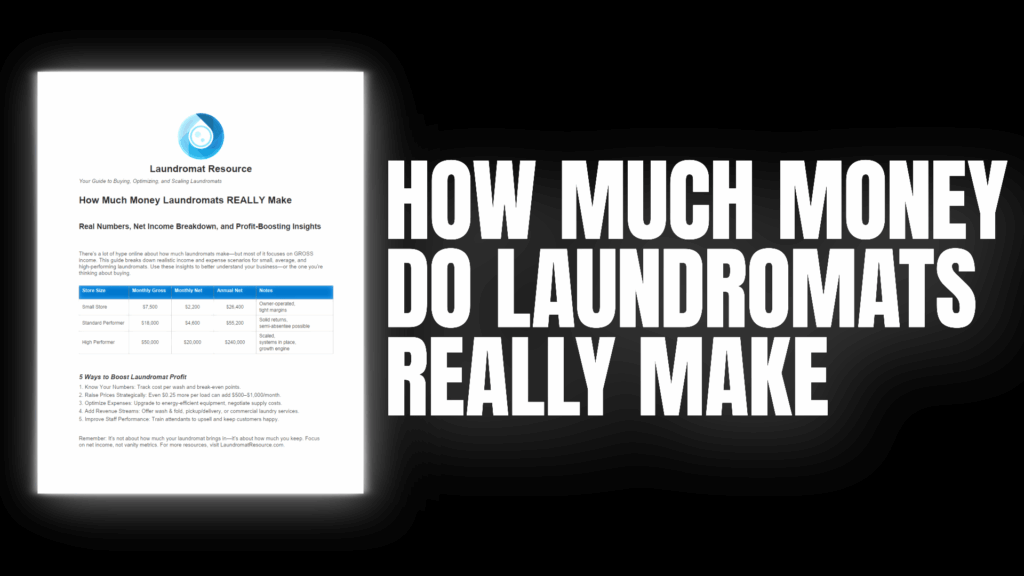
Have you ever wondered how much money laundromats really make? In this episode of the Laundromat Resource podcast, host Jordan Berry pulls back the curtain on one of the most common questions in the industry: what are the real numbers behind laundromat income? Forget the flashy social media posts featuring piles of quarters and eye-popping revenue headlines—Jordan breaks down the difference between gross income and the profit you actually get to keep.
Join us as we dive into three realistic laundromat scenarios—from a small neighborhood shop to a high-performing, full-service operation—and learn what truly separates average stores from serious money makers. Whether you’re thinking about buying your first laundromat or looking to boost profits in one you already own, Jordan shares actionable tips, industry insights, and honest talk about what it takes to succeed (and what those viral videos aren’t telling you).
Ready to get real about laundromat profits? Let’s get into it!
Key Takeaways:
Net Income Is What Matters—Not Just Gross Revenue
Jordan emphasizes that the cash you see in videos or hear in big revenue claims doesn’t reflect what owners actually take home. The “fat stacks of cash” are gross income, but after deducting rent, utilities, payroll, supplies, maintenance, loan payments, and other expenses, the real profit (net income) is much lower. Always focus on net income when evaluating your business or considering a purchase.Know Your Numbers and Continuously Optimize
Owners should have a clear handle on all costs and profit margins. Tools like pricing calculators are essential for understanding the cost per wash and identifying your break-even point. Additionally, profitability can be boosted by raising prices strategically (even small increases can have a big impact), optimizing expenses (energy-efficient machines, negotiating better rates), and keeping a close eye on underperforming areas of your business.Scale and Services Make a Difference
While most laundromats net between $2,000 and $10,000 a month, top performers can reach $15,000–$25,000+ by scaling their operations, adding services (drop-off, pick-up, delivery, commercial accounts), and having highly optimized systems and teams. High performers invest in things like marketing, automation, and employee training to separate themselves from the average store.
Bottom line: Focus on actual earnings (not just flashy revenue claims), know and optimize your numbers, and consider scaling and adding services for higher profitability.
Make sure to watch the latest Laundromat Podcast Episode 212
Here’s a link to a downloadable pdf breakdown of what I talk about in this video.
https://www.laundromatresource.com/mp-files/laundromat-income-breakdown.pdf/
Watch The Podcast Here
Episode Transcript
Jordan Berry [00:00:00]:
If you’ve ever wondered how much money laundromats actually make, you’re not alone. There’s a lot of content out there, some of it helpful, some of it, let’s just say it’s a little too shiny. But I get asked all the time, how much money do laundromats actually make? And today we’re going to break down real numbers, talk about net income versus gross income, and walk through three very realistic Laundromat scenarios. And so you can get a clear picture of what’s possible and what’s practical. Whether you’re thinking about buying your first laundromat or trying to boost the profits of one you already own, you are in the right place. So let’s get into it. Let’s talk about one of the biggest misconceptions out there. And you may have seen all those super Fun videos on TikTok or Instagram or YouTube where people are collecting their quarters.
Jordan Berry [00:00:54]:
They have fat stacks of cash. And laundromats, let’s just face, they look like the best thing ever. Well, guess what? I’ve got some pictures and videos of fat stacks of cash. I’ve got them with my kids piled in piles of money. But there’s a reality we got to come to grips with here. When those headlines say my laundromat made $30,000 this month or we’re doing $500,000 a year, laundromats are cash cows. Hey, some of these numbers are technically true, but. But what they don’t tell you is whether that’s gross revenue or net income.
Jordan Berry [00:01:28]:
And let’s face it, there’s a huge difference. So let’s get this straight up front. Gross income is the total amount of money your Laundromat brings in before any expenses. That’s the fat stacks of cash that you’re seeing and the buckets full of quarters. That’s gross income. What we don’t see on those videos very often is that a lot of that gross income, a lot of that money goes to somebody else. It belongs to somebody else in the form of bills or rent or mortgage or salaries, those kinds of things. Net income is really what we’re interested in.
Jordan Berry [00:02:05]:
And that’s what you actually keep after that. Rent, the utilities, the supplies, the payroll, the maintenance, the loan payments, the taxes. Net is what matters. So now let’s walk through three realistic laundromat profiles. A small Laundromat, an average Laundromat and a high performing Laundromat. So you can see how the numbers actually play out. Hopefully this will give you a better idea if laundromats are the right business for you. So let’s take example number one, where we have a small neighborhood laundromat store size, maybe around 1200 square feet, maybe 15 washers, 10 dryers, and it does a gross revenue of 7500amonth.
Jordan Berry [00:02:50]:
Let me tell you what a typical breakdown is and where that $7,500 goes each and every month, and how much of that you would keep in this small neighborhood laundromat. Okay, so with $7,500 of revenue, you’re probably looking at somewhere around $2,000 of rent, $1,000 of utilities, maybe $300 of supplies if you’re lucky, and your equipment’s not too old, but maybe you’re looking at $300 a month of maintenance. And if you got a part time attendant, hey, you might be able to get away with $1200. There’s some miscellaneous expenses like insurance, marketing, etc. Let’s call that $500 altogether. So all in all, that’s $7500 a month that you’re bringing in. You’re keeping maybe $2200 a month. But let’s face it, that’s not too bad.
Jordan Berry [00:03:39]:
How many of US couldn’t use 2,200 extra dollars a month where we don’t have to do a ton? This is not entirely passive business, but it can be relatively passive for that $2200. That’s a small neighborhood laundromat. Okay, so that $2200 a month translates to about 26,000 extra dollars every single year in your pocket. And this type of Laundromat is great for a side income or an owner operator. The downsides to it is that it’s harder to scale and automate those laundromats, typically because the profit margins can get eaten up real fast, you know, and things like rent increases or unexpected repairs really can wipe out that cash flow some months if you’re not planning for them. Let’s dig into example number two. This would be like maybe what I’d call like a standard performer. Like an average store square footage might be like 2000ish square feet.
Jordan Berry [00:04:40]:
Maybe there’s 30 washers and 20 dryers and a typical gross revenue of about, I don’t know, $18,000 a month. Okay, so let’s talk about the breakdown of where that $18,000 of gross revenue is going. And by the way, $18,000 stacked up in fat stacks of, of bills, you know, especially because laundromats Deal, Deal. Typically in ones and fives and maybe twenties. That can get pretty impressive looking on screen. So at $18,000, here’s what it really breaks down to be. Maybe about $4,000 of rent, your utility costs, which would include like water, gas, electric, maybe sewer costs, maybe trash. That’s going to be about $2,500 for a laundromat doing about $18,000 gross, supplies, maybe $500.
Jordan Berry [00:05:31]:
Your maintenance costs, you have more machines, you know, again, if you’re lucky and your machines aren’t too old, maybe you’re looking at $600 a month labor. You might have two attendance now because again, there’s more volume coming in. You got to take care of more customers, you got to store. So maybe you have two attendants that are costing you about $3,000 a month. And hey, let’s face it, you might have some loan or equipment payments happening at about $2,000 a month. That’s fairly common. And then again, let’s show about $800 of miscellaneous expenses and insurance and marketing, that kind of thing. So that $18,000 a month of gross revenue, those fat stacks, those buckets full of quarters of $18,000 worth, puts in your pocket about $4,600 a month, which is not bad.
Jordan Berry [00:06:20]:
And that translates to an annual net income of $55,000. So this is a solar solid owner absent store with pretty healthy margins. This is the kind of business that starts creating financial flexibility, especially if it’s optimized. It’s one of the reasons that I say, hey, a base hit laundromat to it outperforms most other investment vehicles by far when it comes to cash flow. And that the average American can replace their 9 to 5 income with anywhere from 1 to 3 laundromats. Now that is something that’s incredibly, incredibly powerful. And you can see how if one sort of base hit average laundromat is going to net you $55,000 a year. It doesn’t take too many to replace most people’s salaries.
Jordan Berry [00:07:12]:
But listen, you’re not on here because you want to have a small neighborhood store. You’re not on here because you want to have an average performing store. You’re on here because you want to be a high performer. I know you because I am you. And I also want to have high performing stores. So let’s walk through an example of what a high performing store might look like. This is a store that has about 3,000 square feet or more. There are laundromats getting bigger and bigger.
Jordan Berry [00:07:43]:
So 4000 5000, 6000 square foot stores are not all that uncommon. And in fact there’s even some 7, 8 and 9,000 square foot laundromats out there. Something to behold. They’re beautiful and they’re majestic. Pretty cool, but not typical. But again we’re talking about the high performers here. So we’re looking at 3,000 square foot plus on the small end. It might have 50 washers and 40 dryers.
Jordan Berry [00:08:11]:
And the gross revenue might be 40 to 60 thousand dollars a month. And maybe it has a pickup and delivery business or a drop off slash wash and fold service as well. But oftentimes these high performers are doing 40 to 60 thousand dollars a month on self serve and another 40 to 60 on pickup and delivery and drop off service. So these laundromats can really be pumping out the money here if you’re a high performing store. So let’s look at where this $40 to $60,000 a month goes. Okay, we’ll call it 50,000 just to give us a nice round even number. $50,000 a month. How many of us would not like to collect that many dollar bills? That would be great, right? So let’s see where it all goes though.
Jordan Berry [00:08:59]:
Rent for this type of store is going to be obviously more expensive. It’s a larger footprint, you’re doing more business. Landlords are going to charge more for that. So we’re looking at maybe $7,000 a month. Might be more than that. If you’re on the coast set, you would love a $7,000 rent for this size store. But let’s just call it $7,000 for this high performing store doing $50,000 a month. Okay.
Jordan Berry [00:09:23]:
Utilities again probably going to be about six thousand dollars give or take. Supplies about twelve hundred dollars a month. Now listen, you got a greens now. So that maintenance cost is going to go up to, let’s call it $1200 a month. And you’re going to have more labor. Let’s say you’ve got four or more attendants. Maybe they’re processing pickup and delivery orders or drop off orders. Maybe you have a driver.
Jordan Berry [00:09:48]:
In any case your labor costs are probably going to be around $8,000. And you might have some loans out there or equipment loans out there for another $4,000. And again you’re going to have a delivery vehicle if you’ve got the pickup and delivery and you got gas and insurance and everything for that. So let’s call that fifteen hundred dollars a month for that vehicle. And we have our miscellaneous slash insurance, slash marketing bucket of about $1300. So you’re bringing in $50,000 a month. How much of that are you keeping? You’re keeping around $20,000 a month of that now annually, that’s a net income of around $240,000. This is where scale can really kick in.
Jordan Berry [00:10:34]:
Smart pricing, adding additional services, you can really start delving into automation and tightening up your operations can and that those things can turn this high performing laundromat into a serious cash flow machine. Here, here’s the bottom line. Laundromats can be extremely profitable. But don’t get confused by gross income versus net income because gross income does not tell the full story. It looks great online, it looks great in the videos, but it’s not the full story. Your location, your lease, your equipment and pricing strategies, they’re all playing massive roles in how your laundromat is going to perform. So the truth is most laundromats make between 2,000 and $10,000 a month in net income. Top tier operators break into the 15 to $25,000 a month, but they have usually invested in better systems, upsells marketing and they have the premium locations.
Jordan Berry [00:11:35]:
So what separates the decent stores from the money machines? That is the big question, right? That’s what we’re all here to find out. How do we get into that high performing tier of laundromats? Let’s break that down. Number one, you gotta know your numbers. Use tools like our pricing calculator that we [email protected] go to the resources tab and you can see our calculators over there. Those pricing calculators will help you understand your cost per wash. So water, gas, maybe you have injection, detergent, time, maintenance, repairs, rent, all that stuff. You want to know what your break even point is and where you can build in margin without overpricing. Number two, the lowest hanging fruit in a lot of laundromats is being able to raise prices strategically.
Jordan Berry [00:12:27]:
Most owners are underpriced. We’re notorious in this industry for being afraid to raise our prices. But raising even just a small machine, a 20 pound machine price by a quarter could mean an extra 500 to $1,000 a month in net income with no extra work. And in fact if you have a larger store that those numbers can get significantly larger there. Number three, optimize your expenses. Switch to energy efficient machines. Use a smart thermostat or timers for your H Vac. Negotiate bulk supply purchases or even bulk utility purchases.
Jordan Berry [00:13:10]:
Shop around for your insurance. Look for ways to optimize your expenses. Because listen, net income can be raised by increasing your gross income, obviously and or decreasing your expenses. And speaking of increasing your net income or your gross income, let’s talk about number four. You can add a drop off or pick up and delivery service or you can start taking on commercial accounts. Even a drop off, wash and fold customer can generate five to 10 times the revenue of a self serve user. Pickup and delivery can increase your customer radius dramatically and allow you to serve a larger not only a larger geographic area but also a larger demographic population. Commercial contracts like Airbnb, hosts, spas, salons, small hotel or motels, restaurants, etc.
Jordan Berry [00:14:05]:
Create recurring income and larger order sizes to help stabilize your business and allow you to scale more quickly. Number five Train or replace your team. Here’s the reality. Underperforming attendance can kill your profits and great ones can boost sales, upsell services and keep customers coming back. I can speak to this one from experience. A bad employee will cost you money. I had an attendant one time I showed up to the laundromat and and she was outside in a screaming match in front of everybody with one of the customers. I had to let her go right on the spot because that’s not the kind of environment that we want to promote in our laundromats.
Jordan Berry [00:14:54]:
So how much money do Laundromats really make here? The answer to that is the answer to just about everything, which is it depends. But the key is to focus on the net profit, not just revenue. Vanity metrics people love to post online. If you want to go deeper into analyzing your own laundromat or the one you’re thinking about buying, check out our tools and [email protected] go to the Resources tab there. There’s a bunch of them you can download for free. Some of them you need to be part of our pro community and you can check that [email protected] pro to get full access to all our tools, including all of our analysis calculators and pricing calculators. I’ll drop the link down below. If this video helped you, don’t forget to like and subscribe.
Jordan Berry [00:15:42]:
Share it with someone you love who needs to see this in order to help them achieve the financial freedom that they are looking for. In the comments, let me know what number surprised you the most. I read everyone. We’ll see you in the next one.
Resumen en español
En este episodio de “Laundromat Resource”, Jordan Berry responde a la pregunta frecuente: ¿Cuánto dinero ganan realmente las lavanderías? Explica la gran diferencia entre los ingresos brutos (todo el dinero que entra antes de gastos) y los ingresos netos (lo que realmente queda después de pagar renta, servicios, salarios, mantenimiento, etc.).
Jordan analiza tres escenarios realistas de lavanderías:
Lavandería pequeña de barrio: Aproximadamente 1,200 pies cuadrados, con ingresos brutos de $7,500 al mes. Después de gastos, el ingreso neto es de unos $2,200 al mes (alrededor de $26,000 al año). Es ideal para ingreso extra, aunque puede ser difícil de escalar.
Lavandería promedio: Alrededor de 2,000 pies cuadrados, con ingresos brutos de $18,000 al mes. El ingreso neto es de unos $4,600 al mes ($55,000 al año). Este tipo de negocio puede brindar flexibilidad financiera y permite reemplazar el salario tradicional con una o dos lavanderías de este tamaño.
Lavandería de alto rendimiento: Más de 3,000 pies cuadrados, con ingresos brutos de $50,000 mensuales (pueden llegar a $60,000 o más). El ingreso neto puede llegar a unos $20,000 mensuales ($240,000 al año), especialmente si se ofrecen servicios adicionales como lavado y doblado o entrega a domicilio.
Jordan subraya que la clave está en enfocarse en el ingreso neto y no en las cifras llamativas de ingresos brutos que suelen verse en las redes sociales. Además, comparte cinco estrategias para maximizar la rentabilidad: conocer y analizar los números, ajustar precios, optimizar gastos, agregar servicios adicionales y tener un buen equipo de trabajo.
En conclusión, la mayoría de las lavanderías generan entre $2,000 y $10,000 mensuales de ingreso neto, mientras que las mejor gestionadas y en ubicaciones premium pueden superar los $15,000-$25,000 netos al mes. Todo depende de la gestión, la optimización y la ubicación.
Jordan invita a los oyentes a usar las herramientas disponibles en laundromatresource.com para analizar o mejorar su propio negocio de lavandería.


Links from the Show
Become a Laundromat Pro & Join the Pro Community!
Unlock the secrets of laundromat success! Join our Pro Community now to access expert insights, exclusive resources, a vibrant community, and more.