
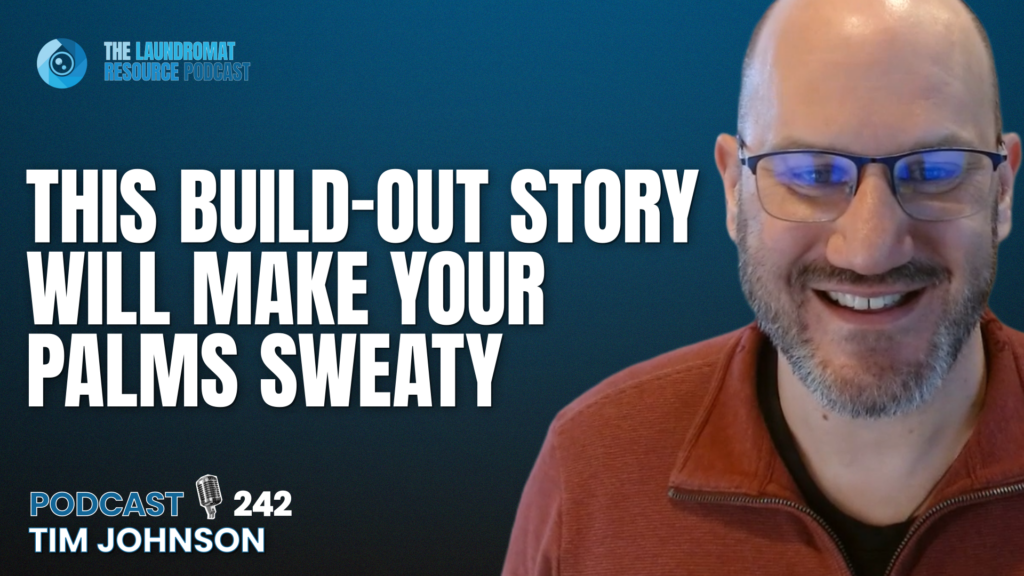
Welcome back to the Laundromat Resource Podcast! In this electrifying episode, host Jordan Berry sits down with Tim Johnson—a decorated former Air Force officer, entrepreneur, and first-time laundromat builder—for an inside look at the rollercoaster journey of launching a laundromat from scratch.
Get ready for an episode filled with drama, suspense, and invaluable real-world insights. Tim Johnson opens up about leaving a corporate career, taking bold risks (including moving hundreds of thousands of dollars’ worth of equipment into his garage with no location secured!), and navigating the high-stakes world of commercial property, seller financing, and construction—all in pursuit of building a laundromat that truly serves his community in Holland, Michigan.
This conversation is more than just a blueprint for business; it’s a masterclass on taking action, handling risk, building relationships, and embracing the inevitable setbacks along the way. Whether you’re dreaming of opening your first location or looking for motivation to push through your own entrepreneurial challenges, Tim Johnson’s story will leave your palms sweaty—and your ambition fired up.
Tune in for practical tips, honest conversation about risk and reward, and a real-world example of what it takes to build something from the ground up. Let’s dive in!
The Power of Community and Relationships
Tim Johnson emphasizes over and over how networking within the laundromat industry is crucial. By building genuine relationships at events like the Clean Show and through outreach to other owners, he unlocked opportunities he’d never have found on his own—like acquiring gently used, high-end equipment at a steep discount and getting creative financing for his buildout. He also stresses the importance of relationship-building at the local level, from working with real estate agents and landlords to city permitting officials and community groups. The community-focused approach continues to guide his marketing plans and vision for giving back.
Relentless Action and Risk Tolerance Are Essential
Tim Johnson’s story is a masterclass in taking bold, consistent action—sometimes before all the pieces are in place. He bought hundreds of thousands of dollars of equipment before even securing a location (and stored them in his garage/storages), secured creative financing, and even demoed the building himself. He addresses the fear of risk and the importance of having a “don’t quit” mentality, being willing to rebuild from scratch if needed. The takeaway for other owners: action leads to progress, but you need the resilience and appetite for risk to navigate setbacks and uncertainty, especially during the buildout phase.
Meticulous Planning for Location, Buildout, and Capitalization
Tim Johnson highlights key best practices in site selection, buildout, and financial planning. He demonstrates the need to be prudent and methodical when choosing your location—having the right co-tenants (like Dollar General, grocers), ample infrastructure (plumbing, electric), and negotiating beneficial purchase terms (like a seller-financed land contract). He stresses the importance of budgeting for holding costs and being prepared to sustain the business without profit for at least a year—underscoring that undercapitalization (or overleveraging) can doom a project. Attention to detail in permits, demo, and scope of construction (with clear plans to avoid costly change orders) also features as a practical takeaway.
In summary:
Network relentlessly and build win-win relationships.
Take action (even when nervous), but have the grit to weather the risks and setbacks.
Plan in detail for location, capital needs, and execution to set your business up for survival and long-term success.
Ready to Take the Next Step?
Check out Laundromat Resource for free courses, podcasts, community forums, and expert consulting—all from Jordan Berry , one of the industry’s leading voices. The opportunity in laundromats is real—whether you’re looking for stable cash flow, a business with meaning, or building wealth with real estate.
If you found these tips helpful, share them—and stay tuned for more industry insights from Laundromat Resource.
Resources and Links:
- Laundromat Resource
- [email protected]
- Facebook: Operation Laundry
- Website: Operationlaundry
Make sure to watch the latest Laundromat Podcast Episode 242
Jordan Berry [00:00:00]:
Hey, hey, what’s up guys?
Jordan Berry [00:00:00]:
It’s Jordan with the Laundromat Resource Podcast. I think this is show 242, and I am pumped you’re here today because today we have Tim Johnson on the podcast giving up his precious time to tell us about his experience building out a laundromat. Now this is, uh, this is, this is like a drama that’s going to unfold before your very eyes. So if you’re, if you’re not in a a place for some suspense, you might want to just wait until you’re ready for it because this is a crazy story. It’s amazing. Tim has done, you know, every episode pretty much I say, hey, go take some action. Don’t waste your time learning only. Go take some action.
Jordan Berry [00:00:46]:
Put it into action today. Tim is doing that to the nth degree here and you’re going to love his his story and coming out of it because he’s taken so much action. He’s learning so much so fast and he’s sharing it with you guys today. So incredible, incredible episode going on and I’m so excited about it. And my palms are a little sweaty because of it that I just want to jump right into it today with Tim. So let’s do it. Tim, thank you for coming on the show, man. How are you doing today?
Tim Johnson [00:01:18]:
Doing great, Jordan. I appreciate the opportunity to come on your show. Big fan.
Jordan Berry [00:01:21]:
Oh, thank you. And thank you for taking the time to come on here. I mean, it’s, it’s huge. You know, anytime somebody gives up some of their day to come chat laundromats with me, I really appreciate it because I always learn a whole lot. And then also I know everybody who listens is really appreciative. So thank you for taking the time. And we got like a unique take going on today, which I’m, I’m very excited about. But before we jump into that, why don’t you just give us a quick rundown of who you are and, uh, and then we’ll go from there.
Tim Johnson [00:01:51]:
Awesome, thanks. Yeah, my name is Tim Johnson. I’m a former Air Force officer and intelligence professional. I spent most of my career building complex systems, people, technology, operations, often in very high-stress environments. After running my own company working in corporate and selling my company as well as a government career, I really wanted to build something tangible, local, and community anchored. And that’s kind of what led me to entrepreneurship and ultimately the laundromats and the opportunity to speak with you here today. All right.
Jordan Berry [00:02:29]:
I didn’t realize I was in the presence of such greatness here. Love that, man. It’s so funny to me sometimes when I talk to people who are in this industry or getting in this industry and like what, what like path they’ve taken to get here. Uh, you know, and this, this business is kind of funny, cuz it’s like people from all over the map can land in this space. And, uh, I, I say you’re probably a case in point, uh, of that where, you know, I, I think you’ll find the stress levels are significantly lower, uh, in laundry than some of the stuff you’ve been dealing with.
Tim Johnson [00:03:13]:
I hope so. I mean, running my own company and then the, the global war on terror and, and the longest war in the history of the United States, there were a lot of operations, a lot of people working together that were pretty stressful. Um, so I’m excited to use those skills in a systems kind of approach and really help out my community. I’ve been blessed to be able to help out at the federal level and in global engagements to support the United States and our freedoms. And I’m excited to be able to assist the community with a laundromat.
Jordan Berry [00:03:42]:
Yeah, well, we’ll have to see, um, you know, as, as, as we communicate here, as we talk about what you got brewing, uh, how the stress of building out a laundromat compares with the global war on terror, uh, or some of these other things you’ve been through. Because I don’t know, maybe it’s not less stressful, uh, The money makes it stressful.
Tim Johnson [00:04:05]:
I think everybody that has been in someone’s shoes that’s building something or starting something and you see money kind of go out the window like water, that can be very stressful because you worked a lot of years. Everybody did work very hard to earn that money and you’re going, man, am I doing the right thing here? Is this going to work?
Jordan Berry [00:04:24]:
Yeah, yeah, yeah. Okay, so, you know, just kind of let everybody know you’re building, you’re currently in the process of building out your first location. And we thought this would be a kind of a cool conversation to have somebody in process of what that process has been like. Real quick, tell us all where, where are you located?
Tim Johnson [00:04:45]:
Sure. Yeah, I’m in Holland, Michigan, which is on the west side of the state, along Lake Michigan. It’s a beautiful community.
Tim Johnson [00:04:52]:
We heat the streets and the sidewalks so you can still visit us in the winter.
Jordan Berry [00:04:57]:
Wow.
Tim Johnson [00:04:57]:
Yeah. Great downtown.
Tim Johnson [00:04:58]:
We’ve got Lake Michigan and Lake Mackinac. So a lot of great water activities and we’re the home of the Tulip Festival. So the Tulip Festival is a big draw for people to come to Holland.
Jordan Berry [00:05:09]:
Okay. I mean, it makes sense, right? Like the, the whole Dutch tulip thing, Holland and—
Tim Johnson [00:05:15]:
Yes.
Jordan Berry [00:05:15]:
Okay.
Tim Johnson [00:05:16]:
All right.
Jordan Berry [00:05:16]:
Well, we also heat our streets and sidewalks here in Hawaii. We use solar power to do that.
Tim Johnson [00:05:23]:
That’s awesome.
Jordan Berry [00:05:24]:
And we have zero snow whatsoever. On our streets or sidewalks because they’re heated by the sun constantly.
Tim Johnson [00:05:33]:
Yes, we get lake effect snow. For those listening around the world, if you’ve never experienced lake effect snow, that is something fascinating.
Jordan Berry [00:05:40]:
I don’t even know what we’re talking about right now. What is that?
Tim Johnson [00:05:43]:
It’s when the storm goes over the lake, it accumulates all the snow. The minute it hits, so it goes over Lake Michigan, which is a long distance. The minute it hits land, it intentionally dumps all snow that it accumulated. In one dump.
Jordan Berry [00:05:56]:
Really?
Tim Johnson [00:05:57]:
Yes.
Jordan Berry [00:05:57]:
You just, if you’re on, if you’re like on the coast there, you’re just going to get pummeled.
Tim Johnson [00:06:02]:
Buffalo, New York is another place. And you know, West Michigan would be another one because of the Great Lakes.
Jordan Berry [00:06:07]:
Oh my gosh. Okay. I’ve never heard of that before in my life. And it sounds awful. Sounds really fun to visit. Yeah.
Tim Johnson [00:06:15]:
Yeah.
Jordan Berry [00:06:15]:
Sounds fun to visit. I don’t know if I could live in it. Yeah. Okay. So Okay, let’s recap. I know you kind of gave us an overview of like why laundromats, but listen, you’ve got like a pretty decorated past here. You’ve accomplished a lot, you’ve done a lot from kind of a broad, diverse background here. So where did the path, how did the path take you to laundromats from where you’ve been?
Tim Johnson [00:06:43]:
Yeah, appreciate it. Well, I was, you know, I had sold my company and I was working in corporate America and there were a lot of layoffs in tech. And, at certain ages, you’re considered a bit old, if you will, or too experienced. And so, that’s a reality.
Jordan Berry [00:07:00]:
Too expensive is what it is. Yeah.
Tim Johnson [00:07:02]:
Ageism. So, I had been laid off from my corporate job and I was kind of figuring out what’s next, what do I want to do. And, I’d been in therapy and working on different things and my therapist said, “Hey, Tim, you’ve done great things for the country. You’ve had the ability to contribute and use all of your education and your skills and your talents.” How can you use that in your community? I think ultimately you should try and use that for something good in the community. And that really landed with me. And we didn’t have an answer at the moment, right? But you kind of let that brew in your head and you think about it. Done a lot of YouTube research, a lot of internet research, a lot of thinking. Of course, I think we’re all aware of all the things on YouTube about laundromats.
Tim Johnson [00:07:45]:
So I started to dig into that. And through my research, I had seen through UpFlip on YouTube somebody that had done pretty well with laundromats, Brian out in Seattle.
Jordan Berry [00:07:55]:
Yeah, and he’s been on the podcast a couple times there too, Brian Riseland.
Tim Johnson [00:07:59]:
Yeah, he’s fantastic. And I reached out to Brian and he was gracious enough to respond to my email and he said there’s something coming up called the Clean Show. And I had no idea what the Clean Show was. And for those in the laundromat industry, it happens every 2 years by the CLA, the Coin Laundromat Association, is a big sponsor. And it’s— I believe it’s the largest laundry conference in the world. That’s how I understood it. And so not knowing how to spell Laundry, I bought a plane ticket, a hotel room, and a rental car, flew myself to Orlando and just started meeting people. And I was blown away by the community.
Tim Johnson [00:08:38]:
Everybody wanted to help. The industries I’d worked in in the past with this tech and corporate and government, there’s a lot of competition and they don’t want to always help you because they view you as competition. In the laundry industry, I always tell people Brian in Seattle, the number one person in Kansas City who you’ve probably had on this show, they, they don’t care that I’m opening one in Holland, Michigan. They’re willing to help, willing to work together. Even Detroit, Michigan isn’t too concerned about Holland, Michigan. And that’s a great community base. And that’s— and I went through the Clean Show, made a ton of friends, networked, and from there really became convinced I could do this with the help of all these individuals. And so came back to Michigan, started looking into it., what it would cost, equipment, reps, land, all the things that I started to evaluate.
Jordan Berry [00:09:29]:
Yeah. Okay. So you just kind of did your research and then took the plunge, bought the ticket, made the trip, started meeting people, started learning. I did.
Tim Johnson [00:09:39]:
I like that. And what was kind of neat was as I was doing all this, everybody’s got to make a decision on, you know, which brand are they going to go with for their machines and all those decisions that go with it. One of my friends from the conference reached out and said, said, hey Tim, you’re not going to believe this, there’s somebody on the east side of the state, Detroit side, that’s going out of business. They’re— they’ve only been around 2 years. They have Electrolux. Their equipment’s been, um, only used for 18 months. Try and get a hold of them. Had no contact information, no real name other than the business.
Tim Johnson [00:10:11]:
I worked really hard to get a hold of them, and I found out who they were, got a hold of the owners, and they were gracious enough to sell me all of everything in their laundromat, which was a brand new 4,500-square-foot laundromat, everything they had at a very steep discount, probably a third of what they paid.
Jordan Berry [00:10:30]:
Wow. Wow. Well, hey, good for you. That’s too bad for them. I don’t know the situation there, but good for you to be able to find that. And that’s, you know, we talk a lot on here about the community aspect of this industry and stuff and You know, I’ve really found in, and this is another kind of case in point that, you know, it’s in those relationships, in those connections that we have with each other where opportunities present themselves, opportunities lie, you know, whether that’s for discounted equipment or, you know, you know, whatever, like helping you grow your business. The one idea that sparks the thing that helps you take your pickup and delivery that helps it take off or, you know, whatever the case may be. It’s so important.
Jordan Berry [00:11:15]:
So if you’re out there and you’ve been a passive listener to the podcast or you’re just kind of browsing around in the industry or you’re just kind of doing your own thing, head down, man, get involved, start meeting some people because opportunities happen when people mingle.
Tim Johnson [00:11:30]:
Jordan, I can’t agree more. That’s the only reason I have a property, a laundromat build going on right now, and equipment. Without those relationships and Brian helping and everybody in the community giving me assistance and mentorship, I would not be where I am. And then I also called on my own community. My neighbor was gracious enough and kind enough to get in a box truck. I got in one box truck, he got in another, and we drove 3 hours to Detroit and we moved 43 dryers and 41 washers plus vending machines and all equipment in a 4,500-square-foot laundromat by ourselves, which— that is a task.
Jordan Berry [00:12:07]:
That’s a task. That is a task. Okay, so at this point in time, did you already have your location that you’re going to be building out?
Tim Johnson [00:12:17]:
I did not. I put all of the washers in my heated garage, keyword heated, because of the winter. Yeah. So they wouldn’t freeze. I put all the dryers in a storage unit, had no idea where I was going to start a laundromat. I just spent hundreds upon hundreds of thousands of dollars to buy equipment for a laundromat that didn’t exist. And I moved it across the state and I stored it in my garage. So then all the things you have in your garage go out in the wintertime.
Tim Johnson [00:12:44]:
You know, they’re out in the snow right now, literally as we speak. We’ve had record snow for 2 weeks and my garage is full of washers and equipment, vending machines, tables, chairs, folding tables, everything. The dryers I put all in the storage unit. Had nowhere where I was going to put this. I was looking for property. The number one challenge I think in a laundromat is finding a location and doing all that due diligence. And so I was in deep into that, owned all the equipment for a laundromat that didn’t exist.
Jordan Berry [00:13:17]:
Okay. I like, okay, so here, here’s the thing is on the podcast, I usually, if, if, if anybody ever makes it this far, usually end this thing with like, hey, you got to take action. Action’s what’s going to get you where you got to go.— like, dude, you’re taking the action here. You’re jumping on the plane, going to the Clean Show. You’re buying hundreds of thousands of dollars of equipment without any place to put it. I mean, was anybody in your life just telling you that you’re crazy?
Tim Johnson [00:13:50]:
Oh, a lot of people.
Jordan Berry [00:13:52]:
Okay.
Tim Johnson [00:13:52]:
Okay.
Jordan Berry [00:13:52]:
Yeah.
Tim Johnson [00:13:53]:
Almost every person I spoke to thought I was insane. Thought that I was wasting my money, thought that I would fail, thought that the math didn’t work, that I overpaid on the equipment because, you know, they don’t know the industry, that I really did get a great deal. And why would I take my garage space and fill it with all these big pieces of equipment that I can’t run? I can’t move them, you know, they’re heavy. What am I going to do with all this? And I came from tech, you know, Harvard Business School. Air Force Academy undergrad. I had all this air quote education and they all thought I should be doing something, you know, the white collar, not moving washing machines, not doing a laundromat. But I was convinced this was the right thing for me and my community and I wanted to learn by doing, right? I didn’t want to sit back and play Monday morning quarterback and evaluate others and say, would’ve, should’ve, could’ve. I did the ROBS, the rollover for business startups.
Tim Johnson [00:14:50]:
I cashed it in. I’m all in. And so, I just went for it and took a lot of action and a lot of risks that people don’t have tolerance for.
Jordan Berry [00:15:01]:
Yeah, dude, I love it. I love it. And I’m sure it’s giving people sweaty palms right now. Just in case you don’t know that, ROBS is a way to utilize retirement funds to start a business or buy a business. So, that’s an option for anybody out there. Go look into ROBS if you’re out there. I know you’re giving people sweaty palms right now by buying all this equipment, using retirement funds to do it, kind of all that. So you’ve got this stuff in your garage.
Jordan Berry [00:15:31]:
I, at one point also, for a much less intelligent reason, had a garage full of equipment where I bought a store and I retooled it. And the installer told me that he would haul the equipment away for free. And I was like, no, like this, this still has some value. Like you could, I’ll sell it to you. And he’s like, nah, I don’t wanna buy it. So I decided that I would sell the equipment. And so I moved it all by myself into my garage and it was just not, I should have just given them to the guy. So, uh, not, not as, yeah, not as intelligent as what you were doing, uh, over there.
Jordan Berry [00:16:11]:
Just me trying to make a buck and. Being foolish about it.
Tim Johnson [00:16:17]:
Yeah. I was trying to save a buck, right? That’s why I bought all these stuff to save a buck. Although everybody viewed it as spending a lot of money because it’s hundreds of thousands of dollars and the, yeah, the moving of it. I saved a lot of money, probably $50,000 in moving costs just by moving it myself.
Tim Johnson [00:16:34]:
Yeah.
Jordan Berry [00:16:35]:
Yeah. Well, and listen, saving a buck, By storing brand new equipment until you’re ready for it is much smarter than trying to make a buck by storing super old equipment in your garage and trying to sell it. I’ll just say that. So you’re, I don’t think you’re in the right place is what I’m trying to tell you right now. I understand what you’re going through and your thought process, and it makes sense to me. Still, still, still bold though. Still bold. A bold move.
Jordan Berry [00:17:07]:
Okay, so you have all this equipment, it’s in your garage, it’s in storage, it’s all over the place. All your fun stuff is out in the snow buried, you know, for months at a time here. Have you found a location to put this laundromat yet?
Tim Johnson [00:17:23]:
Yeah, I appreciate you asking. I went through a lot of iterations in the search. I did find a location and it was for lease at the time. And I was very motivated to try and purchase it. And so I contacted the owners who are local, but they run a large private equity group out of Grand Rapids, very successful. Got ahold of the, the wife of the group, spoke to her, met with her, told her my story, told her who I’m about and why I want to do this for my community. And she owns properties all over West Michigan and in Michigan. So she knows Holland and she knows the community and that there’s a need for this, a destination laundromat that the community can have dignity to use and it will be reliable for them.
Tim Johnson [00:18:10]:
So she allowed me— very gracious. They both allowed me to buy it on land contract. And so that was huge because the financing for that is better than any bank from a percentage. Now I’m taking risk, but again, you think I’m scared of risk if I’m moving all that equipment and doing all the things and selling Rob’s. I sleep easy. So I was very lucky that they allowed me to do a land contract and buy the property outright. 5,000 square foot next to a Dollar General, a Mexican grocery store, a Goodwill, a Spanish-speaking church, and O’Reilly’s. It’s a great location as well as like a Starbucks coffee type in the front, which drives a lot of traffic at about 15,000 to 20,000 vehicles going past us every day.
Tim Johnson [00:18:59]:
And the Dollar General and the Mexican grocery store are staple. We’re getting, you know, 5 to 10 people every 5 minutes buying groceries.
Jordan Berry [00:19:09]:
I mean, those are the kind of the indicators that we’re looking for when we’re looking for a location, right? So it sounds like it’s a money location. Just so we don’t leave anybody behind in case there’s people out there not really familiar with real estate, Can you explain what a land contract is?
Tim Johnson [00:19:26]:
Yeah, thanks for asking. I get that question a lot. So when you buy a property, a house, say most people buy a house, you have a bank, pick your bank, Wells Fargo, whoever it may be that’s going to take a loan, a mortgage, they call it a mortgage, and you buy that house and you pay off your mortgage and eventually, hopefully, you own your house maybe in 30 years. When you’re doing a land contract, the bank, is the owner of the property. The people that sold it to me are my bank. They said, you can buy it directly from us. We own it. You can buy it.
Tim Johnson [00:20:01]:
It will be the bank and we’ll have a mortgage with them. And I pay them off with an interest rate that’s better than I would’ve gotten in the industry. They gave me a very good rate that was aggressive and allowed me to buy it from them directly. So I send them checks just like they’re a bank. We keep it on Excel. So we just keep it on Excel to keep what the mortgage is at. It’s— there’s a lot of trust, a lot of faith in everybody when we’re doing that. But remember, relationships.
Tim Johnson [00:20:28]:
They met me, they heard my story, they knew my background, what I’m about and what I do and how I carry myself. And they were willing to take that risk with me. And I knew about them, so I totally wanted that. And it worked out for both of us. And I was able to acquire a 5,000-square-foot property in that way.
Jordan Berry [00:20:46]:
Yeah.
Tim Johnson [00:20:47]:
Yeah.
Jordan Berry [00:20:47]:
And, and, you know, just, just to kind of bring everybody, probably more commonly known as like seller financing, right? That’s what everybody’s looking for. So I just want to make sure. But yeah, I mean, listen, that, that’s like the unicorn, right? Of what everybody’s looking for. Everybody’s looking for a seller financing deal with a good interest rate and good terms. And you know, you’ll hear a lot of people out there saying you can’t find that anymore. Well, I’ll say it’s difficult. It’s probably more difficult now than it used to be. It’s definitely not impossible.
Jordan Berry [00:21:18]:
So kudos to you. What, this particular location, did you find that? Did you have a broker looking for you?
Tim Johnson [00:21:27]:
How did that come about? I appreciate you asking. You know, I was pretty headstrong that, oh, I can do this. I can find my own property. I, you know, look at me. Well, you get humbled real fast. Watch out for hubris. And so I ended up getting a real estate agent and we were working really hard together. I had found some different places on my own that weren’t working out, and the real estate agent had sent me a list.
Tim Johnson [00:21:51]:
And what’s ironic is they had an agent to sell it, to rent it, to lease it. They were— it wasn’t for sale, it was for lease. And that agent really sold it to me because he started to explain the benefits of that location for a laundromat and some of the demographics and why it would work. And he really opened my eyes as to why it was a great location. Then I went to him and said, hey, I’d like to buy it outright. He understood from an infrastructure cost, when you’re looking at gas, electric, water, the amount of money you’re going to pour into this facility, that you’d rather own it. And so he did a really great job, the seller realtor, of communicating to the owners what I was looking to do and then allowed for that meeting to happen where the owners and I could meet and really talk eye to eye. But yes, to answer your question directly, I had a realtor.
Jordan Berry [00:22:40]:
Yeah. Yeah. Well, and cause it’s, it’s tough, right? Like, you know, even, even if, you know, if you’ve never done this before and you’ve never owned a laundromat and you’re just kind of learning the industry, you know, being able to find a property and have the confidence that it’s going to make a return on all the investment that it takes for, like you said, all the infrastructure that you’re going to have to build out, you might have to upgrade water lines. Might have to expand the electrical panel, you know, all kinds of different things, plus all the plumbing and electrical work and ventilation and all that stuff that needs to happen to turn this building into a laundromat, plus all the equipment costs and all that, right? Like to have the confidence that that space is going to make money is difficult if you’ve never done it before and you’re trying to do it on your own. So, and it’s scary, but I thought, you know, if anybody would be crazy enough to do it. It might be you.
Tim Johnson [00:23:40]:
So I’ll tell you how crazy I am, Jordan. Not only did that all true, it was 5,000 square feet full, full of a restaurant. It had all the freezers, all the sinks, all the other— all the furniture, mold, black mold, rust, animals. It had it all. I demoed it myself. I asked the same neighbor who helped drive the box truck Hey, do you want to demo a 5,000 square foot building? And he said, sure, let’s do it. So we demoed that in over 30 days. I documented on my YouTube channel and, uh, we cleared out 22 tons of material out with a wheelbarrow and buckets because we couldn’t get a Bobcat in there because the other neighbors, they can’t have the exhaust.
Tim Johnson [00:24:25]:
So yeah, I’m crazy enough to take these things on.
Jordan Berry [00:24:30]:
I love it. I love it. Getting the hands dirty, getting the hands dirty. Okay, so you found this property and you locked it up on a land contract seller financing deal.
Tim Johnson [00:24:41]:
How long ago was that? I closed that deal in the first week of November and we’re now in February.
Jordan Berry [00:24:48]:
Yep. Yeah. Okay. And then what happened? Panic set in yet or no?
Tim Johnson [00:24:54]:
I’m sorry, say again?
Jordan Berry [00:24:55]:
I said, did panic set in yet or no?
Tim Johnson [00:24:58]:
Not yet. Well, move faster, always move faster. Every day I’m thinking I gotta do more, I’ve gotta be quicker. And the reality is stuff just takes time. So, I sought out an architect immediately. That was hard. Finding an architect was difficult. I went through about 6 or 7 architects.
Tim Johnson [00:25:15]:
Not that there’s anything wrong with the ones I went to, but, oh, that’s not for me, or that’s not the right fit, or I’m too busy. So, eventually found an architect out of Grand Rapids and hired the architect. To design plans for a laundromat. During this time, I was working with Electrolux to get financing for the buildout because I knew the buildout was going to be expensive. And so what I did was, I think it was the first time in the history of Electrolux, I hopefully don’t mind me telling you this, they used my used equipment that I bought from Detroit as collateral. They sold me no new equipment. And they financed my build-out.
Tim Johnson [00:25:54]:
So they gave me financing to be able to do my build-out in addition to my ROBS.
Tim Johnson [00:25:59]:
So I’m doing that in parallel. I’m finding an architect and I’m doing demo and I’m looking for a builder. So, and permits, permits, looking through all those at the same time as every day I’m hauling tons in a wheelbarrow out to the back dump area. So that was all ongoing in parallel the minute I closed.
Jordan Berry [00:26:25]:
Getting after it. Getting after it. Yeah.
Tim Johnson [00:26:29]:
Okay.
Jordan Berry [00:26:30]:
Well, I don’t, I don’t think Electrolux will mind you saying that.
Tim Johnson [00:26:33]:
If so, then I’ll hear about it.
Jordan Berry [00:26:35]:
Fantastic partner. I know those guys. So yeah, they’re great. They’re great.
Tim Johnson [00:26:39]:
Yeah.
Tim Johnson [00:26:40]:
Yeah.
Tim Johnson [00:26:40]:
I met all of them at— it should be known I met all of them at the Clean Show. So, when I approached them, they already knew my story, the relationships, they knew who I was.
Tim Johnson [00:26:51]:
I had sat down with them for hours at the Clean Show, met with the CEO of the United States, all of those things.
Tim Johnson [00:26:58]:
So, there was a good reputation about me and a relationship that already existed before I asked for this.
Jordan Berry [00:27:05]:
Yeah, yeah, which is great. And, you know, Out of curiosity, I mean, you’re kind of asking for this sort of late in the game. Like you’ve already bought equipment and you’ve bought a build. Like what happens if they say no to that?
Tim Johnson [00:27:25]:
I believe in faith that the laundromat is for me and that this is what God has asked me to do with my skills and my ability and my talent for the community. I would’ve found another way. I am— I don’t stop. I don’t quit. I would have kept working at it. And you got to remember relationships and people, they’re willing to help if you ask for it and, you know, are respectful about it. I found more people willing to help in the laundromat community than not help, and it’s been fantastic. So I, I was already in parallel to Electrolux.
Tim Johnson [00:27:55]:
I had found financing through the Clean Show. I had approached multiple banks. I was looking at the SBA. The federal government shut down because of the closure. No funding. So, that was ongoing as well. So, all of that again in parallel to the other activities that I listed off, I had backup plans to the original plan if it didn’t work out. Yeah.
Jordan Berry [00:28:19]:
Good. Well, and the reason I asked that is I knew your answer would be, you know, there’s a way, I’ll find the way, like there’s a way. But the reason I asked that is because people get hung up. On that a lot. And, you know, you know, it not, it’s not for everybody to just jump and then build the plane on the way down, kind of like what you’ve been doing.
Tim Johnson [00:28:43]:
Right.
Jordan Berry [00:28:43]:
And, uh, and I get that. Um, but you know, one of our, one of our core values over here is default to action, right? Like you gotta default to taking action. Cause if you don’t take the action, you don’t go anywhere. You don’t get anything done. Nothing gets accomplished. Um, so I wanted to hear kind of how your mindset was around that. Um, because I, I just talked to so many people every week who, um, you know, rightfully so, but have this fear that paralyzes them, um, and doesn’t allow them to make progress on, on their goals. And, you know, the thing that you said that I’ve found to be a pretty common mindset for anybody who’s successful at anything, laundry or anything else, is you said, I don’t quit.
Tim Johnson [00:29:35]:
Right?
Jordan Berry [00:29:35]:
Like, and I think that’s kind of just a mindset that you have to have is like, are, like, are you in or are you out? Right? So it reminds me, I think Grant Cardone’s book, Be Obsessed or Be Average, right? If you’re not obsessed, if you’re not all in, nothing extraordinary is going to happen.
Tim Johnson [00:29:52]:
Right?
Jordan Berry [00:29:52]:
And if you’re looking to make a huge impact in your community, or you’re looking to, leave your 9 to 5, or you’re looking to have financial freedom, or you’re looking for more time with your family and kids, or, you know, whatever, you’ve got to have a vehicle to help you accomplish those things. And then you just got to be all in on it. And you’ve got to have that, I just, I don’t quit mindset and attitude to get a good one.
Tim Johnson [00:30:18]:
So, and failure is part of life, right? That, that’s, I’ve failed more times than I’ve ever succeeded. And you learn that you just keep going. I fail all the time, every day, different things, and I run a successful business and sold it. Well, that’s the story everybody wants to hear. They don’t want to hear about what it took and the failure and not quitting. So you’re exactly right. Take action. Be smart about your time.
Tim Johnson [00:30:43]:
Be respectful of others. Live with integrity. And I’ve been very blessed in that regard by doing those types of actions.
Jordan Berry [00:30:50]:
Yeah.
Tim Johnson [00:30:50]:
Yeah.
Jordan Berry [00:30:51]:
When you get this laundromat totally finished and built out, people are going to come visit it. Other owners and stuff are going to come visit it and be like, or prospective owners and be like, wow, this is great. I wish I had this, but they’re not going to be seeing you with, you know, moving all this equipment across the country and having to live with it or across the state and having to live with it in your garage and you hauling out tons and tons and tons of debris and stuff from the local— everything that went into it. But it’s that I don’t quit attitude, that obsession to, hey, I’m trying to do something. You said, I believe God called me to do this for my community. That why behind what you’re doing is what is going to drive you to be successful. So, I just want to kind of explore that a little bit because I just talked to so many people who, I think, need to hear that and need to adopt some of that into their life. And it’s just good for me to hear it again for myself.
Tim Johnson [00:31:51]:
No, I agree, Jordan. It’s fantastic. And when you’re motivated with faith like that and you have a calling and it wakes you up in the morning, it can do amazing things. And teamwork and other individuals and relationships, I really want to stress that. That’s what leads to success. I don’t do this alone. I do this with God and my community and my neighbors and the people that want to be part of that and help me, and I help them. And it’s a team effort.
Tim Johnson [00:32:15]:
It always has been my whole life.
Jordan Berry [00:32:18]:
Yeah. Yeah. I think the real question here is how do we get a neighbor like your neighbor who’s willing to go haul a bunch of stuff across the state and bring a bunch of debris out? That’s the real secret right here. Great question.
Tim Johnson [00:32:29]:
We call him the best neighbor in the United States.
Tim Johnson [00:32:34]:
Fantastic.
Jordan Berry [00:32:35]:
Yeah, sounds great. Sounds great. Shout out to, to the neighbor there.
Tim Johnson [00:32:39]:
Yeah.
Jordan Berry [00:32:39]:
Uh, where, where are you at right now in the process?
Tim Johnson [00:32:42]:
Where, where are things sitting? Yep, thanks for asking. We were, we’re permitted, we’re legally permitted to build.
Jordan Berry [00:32:48]:
Construction started 2 days ago.
Tim Johnson [00:32:50]:
Yeah. Oh, nice. All right, we’re putting up a 26-foot I-beam right now in the middle of the lot yet because there was some structural issues that we’re addressing, and, uh, we’re in the middle of the build. Should The goal is to finish by May 15th, which is about 90 days from now, and open for business. So there’s a lot of moving parts that we can cover, and I know you’re well aware of all the things that go into that, but it’s constant every day. It’s funny, people ask me, what are you going to do tomorrow, Tim? And yes, I believe in calendars, I believe in schedules, I believe in all of that. But I usually say, you know what, I’ve got this huge gap of time. I guarantee my phone’s going to ring.
Tim Johnson [00:33:27]:
And there’s something going to be for the laundromat. It’s going to be great. We’re going to work on it and figure it out.
Jordan Berry [00:33:33]:
Yeah. Yeah. Yeah. Okay. So you’re, I mean, you’re like in the thick of it right now. So, you know, in terms of, you know, again, like one of the, one of the, one of the things that can be expensive is the time, right? To, and, you know, I know you have a plan for about 90 days from now to be up and running, but I mean, you said you got this this in November. So we’re talking 4 months to get to this point, which is, I’m assuming demo and the permitting process was probably a huge part of that process. How did you like budget in holding costs for this time?
Tim Johnson [00:34:16]:
Or I did. How did you think about this? Yeah, I’m budgeting for, you know, if we want to get into turns and all that, what’s it going to look like? But I’m, you know, I’m budgeting for a year of no profit. I mean, I am budgeting to be prepared to work at a loss and fund this the entire way and carry it. So, I definitely budgeted for that. And, every day I woke up with a sense of urgency to take action and move this closer to getting started because you have a great point, Jordan, every day costs me money and it’s expensive. And, people, I think you want to talk about sweaty palms, if they knew the bills and the amount of money that shoots out of my checking account, on a daily basis, I think they would not want to think— I mean, they wouldn’t sleep well at night. And it’s big checks. And I always tell people, people that understand taxes potentially or have challenges with tax information, you usually have to earn about double what you spend.
Tim Johnson [00:35:13]:
So if I’m spending hundreds of thousands of dollars, I earned double that. That’s a lot of years and a lot of business.
Tim Johnson [00:35:22]:
Yeah.
Tim Johnson [00:35:22]:
Yeah.
Jordan Berry [00:35:22]:
And a lot of risk, right? Like you’re putting it on the line for this thing.
Tim Johnson [00:35:28]:
I’d like to address the risk because I do know risk can be paralyzing and you talked about that. My background and the privilege I’ve had to live and grow up in the United States, I did not grow up the way I live now and the great opportunities I have at this time. My mom worked two jobs and allowed me to have success and really stress education, which allowed me to go to the Air Force Academy, which is free. And they paid me to go there. So this country provided me with great opportunities. My mom did as well. And so I think about risk and how I started and what’s the worst that happens is I start over to that. That doesn’t scare me because I made out of that and I made it out with people that helped, like my mom and others.
Tim Johnson [00:36:07]:
So if I default to that, I know that I can rebuild myself and do it again. And I guess it’s that confidence to have that, you know, God, my country and my community will help me get there. And with me working hard, something positive will happen. So I’m able to take on that risk.
Jordan Berry [00:36:24]:
Yeah. Yeah. And, and the other part of it too, that you already mentioned, that I fully believe too, is that, I mean, you kind of said like, hey, failure’s part of life. I actually kind of think that there’s no such thing as failure. I mean, my, one of my biggest failures was buying my first laundromat. Like I could not figure out how to, I like lost a bunch of money. I couldn’t figure out how to make it work for like a couple years. I was losing money every single month.
Jordan Berry [00:36:51]:
Checks were going out the door with no prospect of any of it ever coming back. And, but, you know, even, and it was a rough time for me just personally and emotionally. And even in my marriage, like when you have financial stress, you got relationship stress too. Right? So all of that, But I mean, Laundry Mat Resource doesn’t exist without that experience and everything that’s happened since then was because of that, you know, quote unquote failure. Right. And so when you talk about risk, I think we kind of overemphasize risk, especially if you’re somebody who has that, you know, I don’t quit attitude. Sometimes our biggest failures lead to our biggest opportunities.
Tim Johnson [00:37:45]:
Even so, they really do. I wouldn’t be here if I hadn’t been laid off. There’s no way. Yeah, I go through the cycle of thinking about what am I going to do with my life? Corporate America is not working for me. This laying off constantly in tech, this isn’t healthy. And finding a new approach to life. I wouldn’t be on this podcast. I wouldn’t have a laundromat and a property and all the blessings that have come my way.
Jordan Berry [00:38:08]:
Yeah.
Tim Johnson [00:38:08]:
Yeah.
Jordan Berry [00:38:09]:
I mean, could you even imagine your life if you’ve never come on this podcast?
Tim Johnson [00:38:14]:
Like, is it even—
Jordan Berry [00:38:16]:
Sorry, what was that? I said, could you even imagine life if you never came on this podcast?
Tim Johnson [00:38:21]:
Like, I know this is life-changing. Well, I mean, I feel like that’s like being on Oprah.
Jordan Berry [00:38:25]:
I mean, yeah. Yeah. Is it even worth living, you know, that kind of life? I don’t know. No, I’m just kidding. Okay. So, What, what’s on tap? I mean, you’re, you’re kind of like breaking ground here the last couple of days. What’s on tap for this buildout? What is it looking like for you? What’s the plan? I think if we could just kind of give people an overview of what that’s going to look like, I think that’d be helpful for people to kind of conceptualize.
Tim Johnson [00:38:52]:
Anybody who’s considering building out. Thanks for asking. Yeah, we have. And some of these words are going to be pretty laundromat heavy. I know you understand them, but if you’re new to the business, you can Google some of these because I did not know these words 6 months ago. If you would have said all these words 6 months ago, I would not have known what they meant.
Tim Johnson [00:39:10]:
So, and that’s okay if you’re there. I was there too.
Tim Johnson [00:39:13]:
So when we walk in, we’re going to have a greeting counter to the right with 3 vending machines with a roll-up desktop that you can kind of greet people there, take payment. We’ll have Laundry Works, 2 kiosks of Laundry Works with a cash acceptor to take the Laundry Works.
Tim Johnson [00:39:29]:
We’ll have 7 bulkheads that go into the depth of the 5,000 square foot laundromat facility. 6 80-pound washers, 6 65-pound washers, though in a total of 40 washers will be on. We bought more than we’re going to actually use. We’re only putting 40 in the store. That’ll be along one wall, which is the southern wall. And the bulkheads are from Highmark. We went with the Highmark bulkheads, 7 of those that was very expensive. And those go along.
Tim Johnson [00:39:59]:
We have a play area, 10-foot by 10-foot play area for kids. When we say we, it’s really just me, but I feel I always use the word we because there’s the builders, there’s everybody.
Jordan Berry [00:40:10]:
It’s a team effort.
Tim Johnson [00:40:12]:
Yeah, yeah, yeah. 40, 43 dryers on the north wall, you know, 80-pound dryers all the way down to, you know, 20-pound dryers.
Jordan Berry [00:40:22]:
Everything’s Electrolux.
Tim Johnson [00:40:22]:
And as I mentioned, Laundry Works, we’ve got Wi-Fi throughout with wireless access points and two bathrooms that are unisex controlled through Laundry Works. So you’ve had to have spent money on your card within, say, the last 4 to 6 hours to open the bathroom doors. And then I have a wash and fold area in the back that’s private that the workers can do wash and fold and, you know, take a lunch break. You know, have a cafeteria-type area there, watch TV. We have a delivery dock for semis with a roll-up garage door. So depending on how this works, if we ever get to delivery or however it may work out, we have that ready. I have an office for myself in the back for kind of HR reasons, you know, whether that be talking with employees, taking meetings, taking calls, everything that might need to be done. Talking about the risk, I’m prepared to sleep in that office if I lose my house.
Jordan Berry [00:41:21]:
Napping.
Tim Johnson [00:41:21]:
Yeah. If everything goes out and I lose my house and everything I got, I’m moving into the laundromat. So, I’ve got the office prepared for that. But, that’s kind of the layout of what we’re looking for, cement floor. It’ll be polished. And yeah, really open concept, meaning you can see from one end all the way to the other, open ceilings, and put in some windows in the back in addition to the front windows to bring in more light, make it clean, efficient, safe, everything along that. And we call ourselves Operation Laundry, worked out a lot on Laundry Boost with signage and marketing, got great signage, and we’re continuing to work on that.
Jordan Berry [00:42:01]:
Nice. Are you doing, for your drop-off area back there, are you doing machines back there or just a place to fold?
Tim Johnson [00:42:12]:
Great question. That— we went back and forth on that in design. I appreciate you asking that, Jordan. And sometimes if you’d asked me, I would have said we’re doing machines in there, we’re doing machines in there. And at the end of the day, we put all the machines out for the customers and there aren’t any back there. That doesn’t mean at some point in the future we might not add that. We also— I forgot one thing that’s back there. We made ozone, we put in ozone, so that’s going to be pumping the gas throughout the cold water.
Tim Johnson [00:42:37]:
We have an ozone room that it’s loud, that pumps and makes noises. We put that in its own little separate room in the back. Um, but yeah, to your question, we didn’t put any washers back there. The staff will be out. I like that idea, uh, because one, I don’t know what scale we’ll be at for wash and fold, and it allows my, um, my colleagues and teammates to be out on the floor answering questions. We’re looking to be bilingual. We have bilingual workers, well, bilingual signage. We’re very focused on Hispanic community in the area.
Tim Johnson [00:43:06]:
We have a lot of migrant workers that work the fields in the summer. And there’s a large Hispanic community in the Holland area.
Jordan Berry [00:43:15]:
Yeah. Are you, are you plumbing that back area now for potentially adding machines later? Or are you going to worry about that later?
Tim Johnson [00:43:23]:
Worry about that later. I’ve spent a lot of money. We can get into the numbers. If people, even with all that savings of buying used equipment, which saved me about $1 million, I’m all in at $1.6 million. I am everything owned, all mine at $1.6 million running laundromat. And that, that is a lot of money to me.
Jordan Berry [00:43:44]:
That, that’s a, yeah, that’s a lot of money to most people, I would say. Uh, yeah, for sure. Especially as that $1.6 is going out and you don’t have any laundromat bringing money in yet. Uh, correct. It’s, it’s scary.
Tim Johnson [00:43:59]:
That’s scary. You’re having a bunch of equipment in your garage.
Jordan Berry [00:44:03]:
That’s right. That’s right. You at least connect some of it up so you could use it while it’s there. I’m glad you asked that.
Tim Johnson [00:44:08]:
At the Clean Show, I won the grand prize and I won a commercial washer and commercial dryer that they shipped to my house. Yeah, I won it. And so it’s in my house. I use that one. I hook that one up and I run it. Dude, no, who did you win that from? LG, LG, through them out of Wisconsin.
Jordan Berry [00:44:29]:
They, the main corporate there, and they sent it over and shipped it to me. That’s funny. Hey, shout out to LG for sending you a commercial washer dryer.
Tim Johnson [00:44:39]:
That’s pretty fantastic. You’ll get a kick out of it. It’s got a credit card acceptor so I can charge myself if I really want to make myself pay to use my own stuff. Maybe. Yeah, maybe get some return on investment for what’s in my garage.
Jordan Berry [00:44:53]:
I’m just thinking I’d probably be charging the kids to use it for me. Like, hey, I can bypass it myself, but you want to do your laundry, tap that card.
Tim Johnson [00:45:05]:
Exactly.
Jordan Berry [00:45:05]:
That’s funny. That’s funny. Well, dude, you’re just a winner all around.
Tim Johnson [00:45:08]:
I had no idea. I won the grand prize.
Jordan Berry [00:45:12]:
I’m on your podcast. Yeah, that’s right. That’s right. That’s right.
Tim Johnson [00:45:18]:
Okay.
Jordan Berry [00:45:18]:
So how about construction-wise? What’s the plan of action for construction? I mean, I’m assuming you got to jackhammer out some concrete and I mean, you got a lot of stuff going on right now. What about water line? Did you have to upgrade the water line and the meter? Like what?
Tim Johnson [00:45:35]:
What are you having to do? I appreciate you asking that. Yeah, I’m going to answer that and go a little even before that. We put out for bidders with my architect. You know, there’s a lot of different ways to build. I am not a construction expert. This was my first building that I’d ever done. So I relied on my architect as well as my ability to understand what I was comfortable with. So we tried to get the architectural plans very exact to what my needs would be so that when we put it out for bid, we were trying to minimize change orders from the builder, which can really increase costs.
Tim Johnson [00:46:09]:
Yeah. So we put it out for bid. I had 4 companies that I interviewed, which is great. Got to meet them ahead of time, had them walk the site. We had open houses where all the subcontractors, the electricians, the plumbers came in, really got to meet everybody, answer their questions. Not everybody knows about laundromats and they know different things than I know about electricity and water and ventilation. So we went through that whole process, open bid, ultimately picked a winner, and that’s the builder that’s currently building as we have this conversation. To your question about what do we need to do for water, electric, there’s a 2-inch water line already running into the building because it was a restaurant, which was fantastic.
Tim Johnson [00:46:52]:
Another reason, yeah, 600 amps of electric service with its own large breaker outside, meaning a big green box. I don’t know what those are called, like a big green box already there. So I have to upgrade that to 800 amps. Now, that was not cheap. That’s going to be under like an alleyway road that we have to dig and put more conduit. So bring that up to 800 amps. From a plumbing perspective, another reason this location made a lot of sense was the 10-inch drain is out the back door of my building, literally like you would step out the back door and fall in a sewer if they opened the sewer top. So the drain is right there.
Tim Johnson [00:47:30]:
We have to demo and jackhammer large sloths, uh, probably 24 inches to 36 inches of trenches throughout all the cement floor to get to all 7 bulkheads, to get the drain out to the 10-inch drain. You need to put a water line in that, electric in that, drains in that, tie it all the bulkheads, tie to the bathrooms, tie it to the ozone, tie it to the incoming water, tie it to the water heaters. Yes, serious demolition from a cement perspective. Yeah.
Jordan Berry [00:48:03]:
Yeah. Yeah. Well, and I mean, it’s a, yeah, it’s a big deal. Right. And it, I think you’re smart having all this stuff as detailed as possible in the plans. Uh, cause I’ve just seen so many times where, you know, the ozone didn’t get run, uh, with everything else. And so then you got to come up with some different solution, go through the ceiling or, you know, just something not as optimal. So having all that stuff ready to go is going to save you a lot of headache and money, hopefully also.
Tim Johnson [00:48:37]:
I will say too, saving money and headache, you’re right on a great point. The fact that I did my own demo, everybody will say, well, that’s great, you saved money, which I did save probably about $50,000. The actual insight there was, yes, I saved that money, but once you open up that building and you see everything, all of its ugly spots, all the concerns, you get all that garbage out of there, all the walls are gone. The builder has no excuse to say, well, we didn’t know that was behind the wall, or we didn’t know this or that. That saved me, I would guess, easily over $100,000. The structural beam that’s going in as we speak, the 26-foot I-beam, no clue that was needed if we hadn’t done demo.
Jordan Berry [00:49:18]:
Yeah, yeah, yeah. Well, that’s smart. And so the, the I-beam, is that just to shore things up?
Tim Johnson [00:49:25]:
—on the building, or is that—? Yeah, it is, because it used to be— and buildings are buildings. I know that’s a funny statement, but used to be a large grocery store, and then it got broken into separate condos, and there were additions. It’s all cobbled together, all these different strip mall buildings that used to be a grocery store. So when they added on to that grocery store to cobble these things together, they added on to the wall and blew that wall out, and they put 2x4s as the— oh yeah, it’s the beam to be holding up that new addition in the old wall. So I’ve got pictures if you want to see them. True story.
Jordan Berry [00:50:04]:
Oh my gosh. I’m assuming that didn’t get permitted. They just did it.
Tim Johnson [00:50:08]:
No, no.
Jordan Berry [00:50:08]:
It could not have been permitted. Yeah. Geez. Well, hey, I’m glad nobody got hurt and it worked out. And now that’ll have a nice solid I-beam in there. Keep everybody safe. Some, some of the, I mean, you see a lot of that stuff in houses. I feel like you see a lot less in like commercial type buildings because liability goes way out.
Jordan Berry [00:50:32]:
It’s just really risky. It is. It is that, but, um, okay. So, uh, so you’ve got a lot of demo, uh, going the, are you doing, uh, are you doing direct drains? Are you doing troughs?
Tim Johnson [00:50:47]:
What, what’s the plan with that? Yeah, thanks for asking. So the, the Highmark bulkheads come with a trough built in, all the water and electric, it’s one unit. So the troughs, we’re going to sit those down in the cutout concrete and then drain the washers into that trough that then go to the drain out to the 10-inch drain.
Tim Johnson [00:51:07]:
They all kind of connect in and go out that way.
Tim Johnson [00:51:11]:
Yeah. Okay. We looked at, you know, there’s, there’s Highmark troughs. Or not. Hi-Mark. Sorry, I forgot the other trough company’s name. I apologize to them, but we looked at other troughs as well in addition to just Hi-Mark. H&M.
Tim Johnson [00:51:26]:
H&M.
Jordan Berry [00:51:27]:
Is that H&M? Has— Yeah, H&M has troughs for sure. Did you like— you like that these were all integrated or why did you end up going the Hi-Mark?
Tim Johnson [00:51:37]:
Yeah, the finishes on the Hi-Mark, the finishes, exterior finishes of how it looks and how it’s all connected together. I really like that and seeing them at the Clean Show and talking with them and they’re out of Colorado. I went to school in Colorado. So, you know, just all those things combined, talking to the ownership, it, it was a really nice product, a nice finished product that looks very high end.
Jordan Berry [00:51:57]:
Okay. So you got all this construction going on right now. You, you’re hoping about like 90-ish days until open. Are you doing any prep work between now and then to get things ready for the opening?
Tim Johnson [00:52:12]:
Oh yes. I have interior designers that are friends. I have painters that are friends. I’m working on— I took on the role of doing the networking and running the Cat 6 and the 18/4 to control the doors. Learned all about electrifying doors and controlling the doors remotely, opening and closing those remotely so that it can be unmanned or manned depending on what I need, but everything can be run through my phone. So I’m doing all that. I’m in the process continually running that wire and getting ready, buying the wire. So I’m doing those things.
Tim Johnson [00:52:47]:
I am looking at marketing in the community. I created a relationship with what’s called Community Action House, and they service over 10,000 low-income individuals with meals and food and basic goods on a daily basis. They’re here in Holland. They do great, you know, they do God’s work. I coordinated with the CEO there. They get 10% off at my laundromat. So it’s a way to kind of give back to the community. We’re also looking with other community activist groups for disabled and individuals that are struggling to be able to get them a discount at the laundromat.
Tim Johnson [00:53:23]:
So I can’t speak to those because those relationships don’t exist yet, but I’m continuing to grow those. I haven’t done business development yet for commercial accounts. I will do that. I’m not there yet, but I’m going to do it. I think I could have started. I’m hard on myself about that. I think I should already be having those meetings, but there’s a lot going on in parallel at the moment.
Jordan Berry [00:53:47]:
Yeah. Classic entrepreneur symptom right there. That’s how you can find them, pick them out of a crowd of like, hey, this should already have been done and I feel guilty about it and I beat myself up. Yes. Yeah.
Tim Johnson [00:53:58]:
That’s like a daily feeling for me. Yeah. Yeah, I hear you. Yeah. Yeah. I should be able to do more every day. I feel like that.
Jordan Berry [00:54:05]:
That’s right. That’s right. Yeah. I mean, you’re running hard. You’re, you’re getting a lot done. Oh, I remember the question I was going to ask you earlier was, did you have to deal with any like impact fees, tap fees, anything like that for your buildout? I know that some places, I mean, those fees can vary from zero to hundreds of thousands. I looked at building out a 3,000-square-foot space in Southern California, and the, and the impact fee was going to be $390K by itself, and it killed that deal. So I’m just curious where you’re at.
Tim Johnson [00:54:39]:
Did you have to deal with any of those fees? No, I appreciate that question. I did not know those things even existed. The only reason I know they existed is my Electrolux rep started telling me million-dollar horror stories from Florida. And that Electrolux, because of the efficiency in the water, the tables they’re using to calculate those impact fees are not even close to accurate because they’re from the ’70s versus what Electrolux is using in water. They’ve had to really have a lot of conversations and meetings regarding the impact fees not being up to date with the requirements of what these washers could do. The short answer is I had no impact fees. We have, knock on wood, plenty of water with Lake Michigan. And so, you know, we’re doing all right in that regard.
Jordan Berry [00:55:27]:
I didn’t have to deal with that. That’s nice. Yeah, that helps. And then in terms of like permitting, I know that’s another kind of sticky point. Did you run into any issues with permitting? I’m assuming this I-beam is a result of permitting issues.
Tim Johnson [00:55:43]:
Did you run into any other issues? No, I think what was key to me having successful permitting is I was in the permitting office before I even bought my own property. So I met all the players, made relationships, hear the R word a lot, made relationships.
Jordan Berry [00:55:59]:
There’s a theme happening in this.
Tim Johnson [00:56:03]:
Yeah. Talk to inspectors, talk to the local community. What do you need? How can we work together? Joined local networking groups in the community, went to breakfast that we have within the small business community. That doesn’t mean that they didn’t have feedback, right? Worked closely with the architect, worked closely with the mechanical, electrical, and plumbing engineers, had to hire an engineering firm to tie that into the architectural diagrams. We had feedback from the permitting office, but they knew who I was. I’ve opened doors. We invite all of them all the time to come visit. We love to have them see what we’re doing.
Tim Johnson [00:56:42]:
And be part of the community. And that’s been key to having success with permitting. It really wasn’t that bad. Another really big tip for your users, this is a big one. Start the permit way before you ever pick a builder. Well, how can you do that? Have it go under the architect’s name or your name, start the process. And then when you pick a builder, transfer legally, transfer the permit to the builder. We had the day I awarded the, the, uh, contract, the permit was already approved.
Tim Johnson [00:57:16]:
Hmm. Nice.
Jordan Berry [00:57:16]:
Yeah. Yeah. That’s a huge tip. Cause I, you know, and especially depending on what state you’re in and, and what city you’re in, uh, that permitting process can be smooth and quick, or it can be like trying to build anything in LA is like pulling your fingernails out. Uh, no, thank you.
Tim Johnson [00:57:33]:
This took us about 8 weeks for the permit. Yeah. Yeah.
Jordan Berry [00:57:38]:
Which is not, not too bad at all, but that’s a, but that’s a huge tip, right? Because even if like you hadn’t started that permitting process beforehand, you know, in that, that clock started when you hired your builder contractor. I mean, that’s another 8 weeks. And like we were talking about, every day is expensive during this process. Yeah. Yeah. Okay. Um, any, any big plans yet? Or, I mean, it may be too soon still, but I’m sure you’ve at least thought about any big plans for like a grand opening or how to, how to get this thing off the ground as quickly as possible?
Tim Johnson [00:58:16]:
Yeah, thanks. I definitely, we, we’re looking for a lot of marketing, uh, through the internet and locally through business contacts as well as sales. You know, for every, every dollar you spend, you get $2 credit on the Laundry Works card, those types of sales. We haven’t really decided on what those are going to look like, but I’m thinking about them. I’m picking people’s brains.
Tim Johnson [00:58:35]:
I’m talking to other owners and understanding what worked for them. So continually listening to podcasts like yours and other individuals that have good ideas. I’m not the smartest guy in the room. That’s been the case my whole life. There’s people with better ideas and ways that things work, and I love to learn from them.
Jordan Berry [00:58:55]:
Yeah, yeah, yeah. I think that’s awesome. And one, Two things that I’ll say that seems like you’ve got covered, but that I’ve, these are mistakes I’ve seen when people are building out is number one, being undercapitalized and not planning on that year of, you know, hopefully for you, you’re going to be profitable, you know, month one, month two, early on there. But, you know, if you don’t plan for that year of ramping up to profitability, you just, you know, you hate to see somebody going out of business in a year, year and a half. I mean, like the people you bought, I don’t know what happened in that situation, but the people you bought the equipment from, you know, I, if I had to put money on it, it’d probably be that they just ran outta capital.
Tim Johnson [00:59:41]:
So I, I know the answer.
Tim Johnson [00:59:43]:
I don’t think they’ll mind sharing that.
Tim Johnson [00:59:44]:
I haven’t told, they don’t know who they are. They were overleveraged.
Tim Johnson [00:59:48]:
They had too much capital debt and the mortgage payment, they’re back to the word mortgage, the debt payment, was way higher than you would want for your, your business in the laundromat. And if you knew the number, you would immediately know, man, that’s a lot of revenue to generate just to cover the note. And they didn’t own the building, they were leasing the building. Yeah, that was through a franchise. I’m not franchised, I’m not dealing with franchise fees, I’m on my own. So I saved that little bit of amount.
Tim Johnson [01:00:21]:
Now that doesn’t mean they had a beautiful layout. They had great equipment.
Tim Johnson [01:00:24]:
I am a great beneficiary of top-of-the-line equipment, top-of-the-line layout. It just that the debt note was too much interest in payment.
Jordan Berry [01:00:36]:
Yeah. Yeah. So I mean, another way of saying just undercapitalized there and, you know, just too leveraged. So I think that’s a huge mistake that people can make pretty easily. On the build-out side. The other thing on the build-out is you spend all this— the other mistake I see people making is you spend all this money building this thing out. I mean, you dropped a pretty large number there, $1.6 million, right? You spend all this money building this thing out, and either because you’re undercapitalized or because you’re just fatigued from spending money or because you just don’t know what to do or how to do it, you rely on the field of dreams model, right? If you build it, they will come and you don’t get out there and get proactive and invite the community in and be kind of everywhere that you can be early on. And I, those are two massive mistakes I see people making on building out.
Jordan Berry [01:01:43]:
And both of those have the potential to crush your business. Because if you just rely on word of mouth, you know, probably eventually it will work, but it’s going to take a lot longer for you to get enough volume just based off word of mouth alone that it’s going to be hard to survive that long. And number 2 is you’re just losing money until you get people in, right? You’re just losing money.
Tim Johnson [01:02:09]:
Wow. What’s your advice, Jordan, on getting people, you know, getting the word out. What’s your advice on getting involved in the community and getting that going? I agree with you.
Jordan Berry [01:02:18]:
What’s your advice? Yeah. So, I’m going to say this recognizing that, you know, people have lives and limited scope and limited energy and kind of all that. But I mean, really it’s to kind of be everywhere you can be immediately. I mean, you’re going to combine online and offline marketing. There, you’re going to probably have a promotion. Like I really like the double your money promotion, you know, which is where somebody puts a dollar on, they get 2, or they put 20 on, they get 40, right? It’s a really great way when you have a card system to retain customers, to get them in the door because everybody likes free money and it doesn’t cost you $20 to give $20 away. It costs you probably 15 to 20% of that. And so I really like that.
Jordan Berry [01:03:10]:
And then, especially for you, but I think just in general of being everywhere in the community, working with Chamber of Commerce, if you can sponsoring community events. I mean, you mentioned like Tulip Festival, right? Like, I don’t know if they have sponsors, but stuff like that where you can sponsor some of this stuff. And then some of the stuff you were saying too is like, can you cut some deals with nonprofits in the area and give them a discount or, you know, or, or something like that. And then, you know, same, same with like schools, things like that, partnering with schools, you know, washing, you know, I mean, you have ozone so you can wash uniforms. You could, you could wash like football uniforms or whatever for schools and be able to get those cleaned properly. You know, things like that where you know, if you can just kind of spread that net wide, that’s a huge benefit, right? And then if you’re also doing like drop-off or pickup and delivery, I mean, there’s kind of more beyond that as well. Some more specific types of marketing that you can do to business B2B, you know, things like that. So, but I think, you know, having a plan that’s written down and that you execute whatever that plan is is going to be better than trying to wing it, uh, for sure.
Tim Johnson [01:04:33]:
Especially when you got so much money on the line. Yeah, that’s great advice. Um, I like your idea with the tulip time. We have a tulip parade. It’s a whole week of tulip time, and I think if I could get a float in the parade, that would be pretty fantastic. So that’s a— oh yeah, thank you.
Jordan Berry [01:04:49]:
Yeah, yeah, that would actually be— if you do that, you got to send me a picture of your float. Okay, your big washing machine or whatever you do made out of tulips.
Tim Johnson [01:04:57]:
I don’t know, this first year, that’s gonna be timing. It’s gonna be difficult because I have— yeah, yeah.
Jordan Berry [01:05:01]:
When I open, so we’ll see.
Tim Johnson [01:05:05]:
Yeah. Yeah.
Jordan Berry [01:05:06]:
Uh, for tulip time, everybody, it’s fun up here. We’re all making the trip out, uh, to see your float, so don’t let us down. Uh, you’re like, I’m trying to build a laundromat here, I don’t have time to make a float. Uh, that’s funny, but that would be cool, you know, down the line. Yeah, to do something like that. Uh, listen, dude, any— anything else you feel like we need to get through and, and chat about?
Tim Johnson [01:05:30]:
No, if anybody wants to reach out, love to give back to community, check out OperationLaundry.com. That’s our website. You can reach me through there. Really grateful for the opportunity to have this conversation, Jordan, and spend time with you today.
Tim Johnson [01:05:43]:
It’s been a privilege and continued success to you and what you’re doing.
Tim Johnson [01:05:46]:
I know the community at large really appreciates everything you’re doing.
Tim Johnson [01:05:50]:
I know I do, and it really helps other owners and people that are tangential to the community and working alongside us. So thank you.
Jordan Berry [01:05:58]:
Yeah, no, I appreciate that. And you mentioned earlier that you’re documenting some of this stuff on a YouTube channel. What’s the YouTube channel?
Tim Johnson [01:06:06]:
Well, thanks for asking. It’s my own personal Tim Johnson. Contact me, I’ll get you the links. And it’s pretty comical because it’s me being filmed by an iPhone of a friend. And then I do voiceover. This is not studio quality, so get ready for some fun.
Jordan Berry [01:06:24]:
Hey, you know what? Here’s what I’ve learned from doing this podcast, almost 250 episodes now, is Uh, you know, the people who are in, like we talked about being obsessed or be average, right? The people who are in this are in it to win it. Right. And yeah, you’re maybe your content right now is not for the masses, but guess what? My content’s not for the masses either. I’m not trying to get huge numbers. Uh, I’m just trying to get in front of the people that care about this stuff and the people that care about it are going to be interested in seeing the process and seeing how it’s done. So that’s what I’ve learned. I wouldn’t be embarrassed or ashamed about it because I think even just sharing a little bit of the process is going to be super helpful for people.
Tim Johnson [01:07:04]:
Awesome. Well, we’re on Facebook, Operation Laundry on Facebook. I put some of the YouTube channels on there and then we’re on Instagram as well, Operation Laundry, and just Google Operation Laundry or YouTube Operation Laundry will pop up.
Tim Johnson [01:07:18]:
I’m pretty confident.
Jordan Berry [01:07:20]:
Cool. Cool. Love it, man. I appreciate you taking the time and jumping on here, sharing your experience so far. I mean, This pretty much requires us to do a follow-up episode maybe in like a year or so when you get this thing open and you’re about ready to start building your parade float for next year and hearing how it’s going and everything. Because I know for a fact you gave a bunch of people sweaty palms just talking about what you’re doing. And so people are going to want to know how did it go?
Tim Johnson [01:07:56]:
If I don’t make it back on, guys, it means it didn’t work.
Jordan Berry [01:08:00]:
Oh, you’re definitely coming back on if it didn’t work. Uh, and we’ll just, you know, we’ll virtually hug or maybe I’ll fly out there and we can just hug it out.
Tim Johnson [01:08:08]:
Yeah. Come on.
Jordan Berry [01:08:09]:
I’m, I’m pretty confident though that you’re going to make this thing work. Uh, I, I have zero doubts, uh, that you’ve got a huge success on your hands here. It’s just a matter of getting it. To that starting line to get it open and off and to the races. So no, no doubts on my end over here. Awesome. You got it.
Tim Johnson [01:08:28]:
You’re doing the right stuff. Thank you.
Jordan Berry [01:08:31]:
All right, man, appreciate you, and, uh, looking forward to our follow-up episode in, you know, a year or so.
Tim Johnson [01:08:36]:
It’ll be a lot of fun. Sounds great.
Jordan Berry [01:08:38]:
Thank you. All right. Okay, listen, Tim survived, so we can all just take a deep breath, but that was stressful. In the best way possible. So, huge shout out to Tim. I can’t wait to hear how all this plays out for him. Incredible story. And a huge thank you to him for sharing so much information.
Jordan Berry [01:08:57]:
The dog’s even super excited about it, if you’re on the video. But listen, again, as always, take some action, all right? Channel your inner Tim, take some massive action towards achieving your goals, whether that’s going out and, and going out and finding that very first laundromat, uh, to acquire. And by the way, if you need help with that, we have a service that helps you do exactly that. In fact, we have a service that does that for you. Uh, so if you’re interested in that, go book a free strategy call on the coaching page over there, uh, laundromatresource.com/coaching. And, uh, and I’ll tell you all about what it is that we do. Um, but maybe your massive action today is doing something to take your business to the next level, whatever it is. Take some big action, see some big results, and make some palms sweaty along the way.
Jordan Berry [01:09:48]:
That’s— I feel like that’s kind of what life’s all about, right? Right. The dog thinks so. All right. We’ll see you next time. Peace.
Resumen en español
Claro, aquí tienes un resumen en español del episodio:
En el episodio 242 del Laundromat Resource Podcast, Jordan Berry entrevista a Tim Johnson, un exoficial de la Fuerza Aérea y emprendedor, quien comparte su historia al construir su primer lavandería en Holland, Michigan. Tim Johnson explica cómo, después de vender su empresa y ser despedido de su trabajo corporativo, buscaba invertir en algo tangible y que aportara a la comunidad. Tras investigar en YouTube y asistir al Clean Show (la principal convención de lavanderías), se convenció de que podía entrar en la industria gracias al apoyo de la comunidad.
Durante el proceso, aprovechó una oportunidad para comprar todo el equipo casi nuevo de una lavandería que cerró, aunque todavía no tenía un local. Guardó los equipos en su garaje y unidades de almacenamiento mientras buscaba un espacio. Finalmente, consiguió una excelente ubicación de 5,000 pies cuadrados cerca de tiendas clave, que pudo adquirir mediante un contrato de vendedor (land contract), lo que le dio mejores condiciones de financiamiento.
Tim Johnson hizo él mismo la demolición interior, ahorrando dinero y ganando mejor entendimiento del estado del local. Detalla el proceso de permisos, la contratación de arquitectos, y la planeación minuciosa para evitar costos sorpresa. También destaca la importancia de las relaciones en la industria y en la comunidad, tanto para obtener ayuda como para colaborar con organizaciones locales una vez abra la lavandería.
Hablan sobre los riesgos y la necesidad de tomar acción, sin dejarse paralizar por el miedo al fracaso; Tim Johnson menciona que aprovechó sus fondos de jubilación (ROBS) y apostó fuerte por el proyecto. Su meta es abrir la lavandería, llamada Operation Laundry, en unos 90 días tras la grabación. Planea enfocarse en marketing local y colaboraciones con organizaciones benéficas, y recomienda estar presente en la comunidad desde el principio.
El tono es motivador y realista, mostrando tanto los retos como el entusiasmo de emprender en el sector de lavanderías. Finalizan invitando a la audiencia a tomar acción, perseguir sus metas y a conectar con Tim Johnson si quieren seguir su proceso a través de su canal de YouTube y redes sociales.
¿Te gustaría el resumen con algún detalle específico o una parte concreta?
Watch The Podcast Here


Links from the Show
Become a Laundromat Pro & Join the Pro Community!
Unlock the secrets of laundromat success! Join our Pro Community now to access expert insights, exclusive resources, a vibrant community, and more.